
An AI contextual governance solution applies governance controls that scale with the actual context of AI use, the data involved, the risk level, and the system's autonomy, rather than applying the same rules to every AI system regardless of what it does.
Here's what contextual governance means and how to build a solution around it.
What is an AI contextual governance solution? The 30-second answer
An AI contextual governance solution is a combination of policy and technical controls that adjusts oversight based on who's using an AI system, what data it touches, and how much autonomous action it takes, rather than applying a single governance tier to everything labeled "AI."
Bottom line: contextual governance treats risk as situational. A marketing team using AI to draft copy and a clinical team using AI for diagnostic support don't need the same controls, and forcing them into one framework either under-protects the clinical team or paralyzes the marketing team.
Key factors that define context
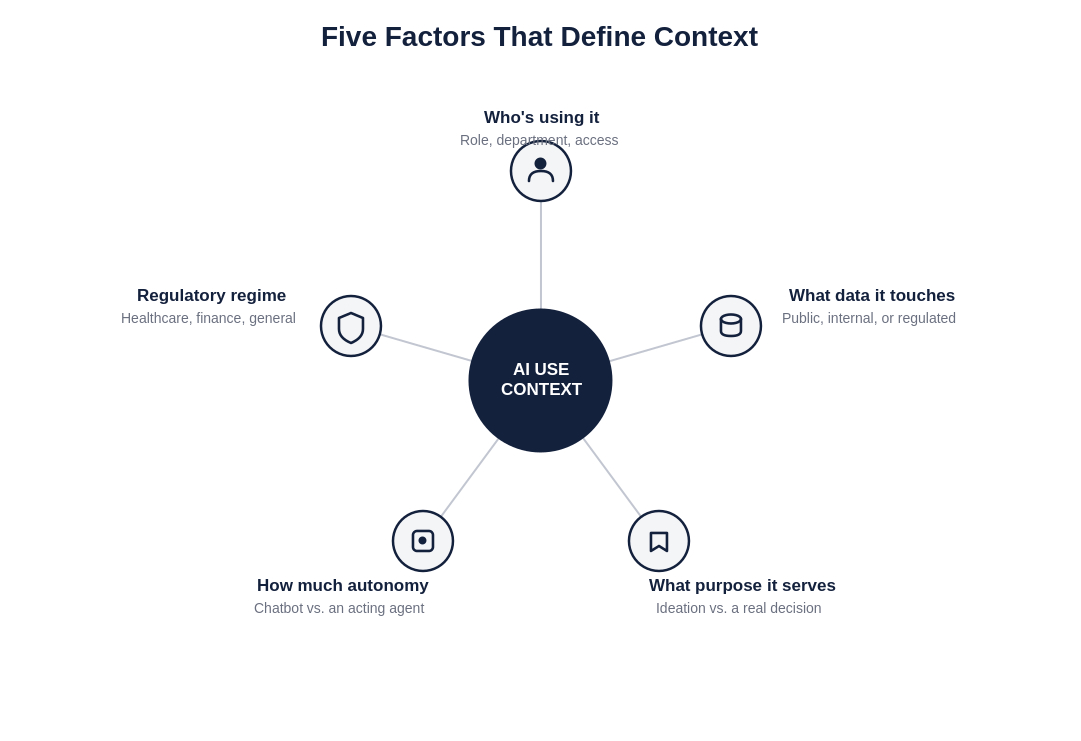
Every framework in this space converges on roughly the same set of factors, even when the terminology differs:
- Who's using it: Role, department, and access level, since a business analyst and a data scientist carry different risk profiles for the same tool.
- What data it touches: Public information, internal business data, or regulated personal data each demand a different control tier. Our AI data governance guide covers what changes when the data itself is the risk.
- What purpose it serves: Content ideation carries different stakes than a decision that affects a customer or patient outcome.
- How much autonomy it has: A chatbot that answers questions is a different risk category than an agent that takes action on production systems.
- What regulatory regime applies: Healthcare, finance, and general business use fall under different compliance obligations for the same underlying technology.
How does contextual governance work?
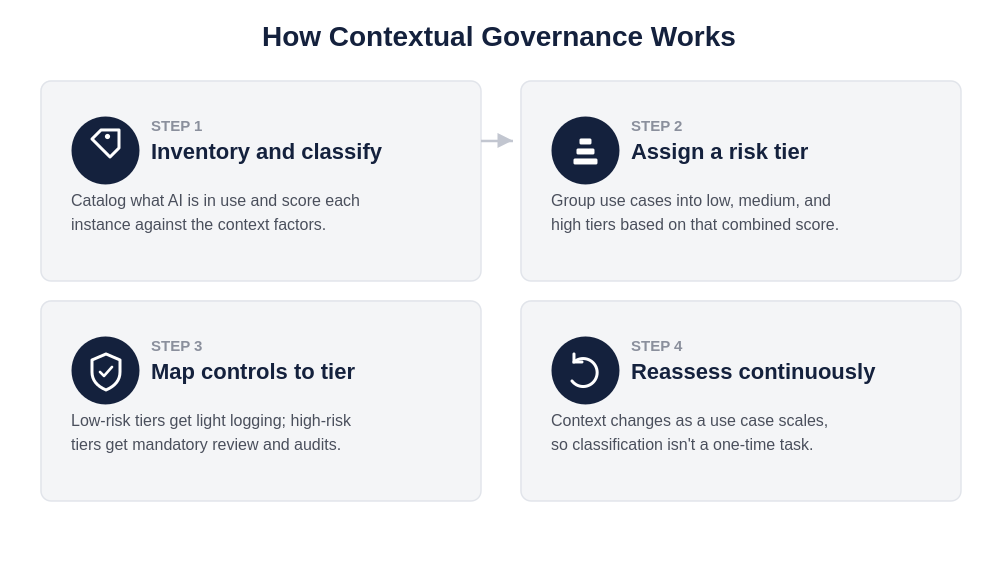
Contextual governance works by first classifying AI use cases against these factors, then mapping control intensity to the resulting risk tier, so low-risk use cases move fast and high-risk ones get real scrutiny.
In practice, that means:
- Inventory and classify. Catalog which AIs are in use and score each instance against the context factors above.
- Assign a risk tier. Group use cases into tiers, commonly low, medium, and high, based on that combined score.
- Map controls to tier. Low-risk tiers get lightweight logging; high-risk tiers get mandatory review, tighter access controls, and audit trails.
- Reassess continuously. Context changes as a use case scales or a data source changes, so classification isn't a one-time exercise.
A practical example: an internal tool that summarizes public press releases needs little more than basic logging.
The same underlying model, pointed at unredacted customer records to make an eligibility decision, needs human review, full audit trails, and restricted access, even though it's technically "the same AI."
AI contextual governance vs. traditional governance: what's the difference?
Traditional AI governance applies one framework across an organization. Contextual governance is built on the assumption that a single framework can't fit every use case.
Here's how they compare:
Contextual governance applies its scrutiny where the risk is, giving routine use cases a lighter touch and high-risk ones a thorough review. Our guide to AI governance covers the broader principles it builds on.
What I liked and didn't like about contextual governance in practice
Pros
It removes the false choice between speed and safety. Teams building low-risk internal tools stop waiting behind reviews meant for high-stakes systems, while risky use cases get scrutiny that a blanket policy would have missed or diluted.
It scales with the adoption of AI. Since most organizations have a small number of high-risk use cases and a long tail of low-risk ones, tiering effort to match that distribution is far more realistic than reviewing everything equally.
Cons
Classification accuracy is the whole system. If a use case gets misclassified as low-risk when it touches regulated data, contextual governance fails exactly where it matters most.
Context changes faster than most review cycles. A tool that started as an internal experiment can start touching production data within weeks, and governance built around a point-in-time assessment misses that drift unless reassessment is continuous.
Should you build a contextual governance solution? My take
McKinsey's 2025 State of AI survey found that 88% of organizations now use AI in at least one business function, yet most are still governing it with a single, uniform policy.
If your organization has more than a handful of AI use cases spanning different departments, data sensitivity levels, or degrees of autonomy, a uniform governance model is already costing you either speed or safety.
Contextual governance is worth building if you:
- Run AI use cases with meaningfully different risk profiles across departments.
- Have hit real friction from a one-size-fits-all review process.
- Are scaling AI adoption faster than a centralized team can manually review.
A simpler model may still work if you:
- Run a small number of AI use cases with similar risk profiles.
- Haven't yet reached the adoption scale where uniform review creates real bottlenecks.
How to build an AI contextual governance solution in 6 steps
Building this out works best as a sequence that establishes classification before automating enforcement.
- Inventory current AI use. Catalog every AI system, tool, and integration in use, including ones outside official channels.
- Define your context factors. Decide which dimensions matter most for your organization, such as data sensitivity, autonomy level, regulatory exposure, or a combination of these.
- Build a risk-tiering model. Score existing use cases and sort them into clear tiers with defined criteria, rather than case-by-case judgment calls.
- Map controls to each tier. Define exactly what changes at each tier, including review requirements, access restrictions, logging depth, and approval authority.
- Automate classification where possible. Manual tiering doesn't scale, so build classification into intake and monitoring instead of a one-time survey.
- Reassess on a fixed cadence. Set a schedule to re-score use cases as they evolve, well beyond waiting for someone to flag a change.
Pro tip: start by tiering the AI use cases you already know about before chasing shadow AI. A working model on known use cases is easier to extend than a perfect model with no real data behind it.
Best practices for contextual governance
A few habits separate contextual governance that holds up from a paperwork exercise wearing a new name:
- Base tiers on evidence over self-reporting: A team's own assessment of its AI use case's risk is a starting point, short of the final classification.
- Keep the tiering model simple: Three or four tiers with clear criteria beat a granular scoring system nobody can apply consistently.
- Automate reassessment triggers: New data sources, new integrations, or usage spikes should automatically prompt a re-review, ahead of waiting for a scheduled audit.
Common mistakes to avoid:
- Treating classification as a one-time exercise: Context drifts, and a governance model that doesn't reassess becomes traditional governance with extra steps.
- Building too many tiers: A ten-tier risk model is harder to apply consistently than a four-tier one, and consistency is the whole point of contextual governance.
My verdict on AI contextual governance solutions
Contextual governance is a genuine improvement over uniform frameworks. The core insight, that a chatbot drafting marketing copy and an agent making decisions on regulated data don't belong in the same governance tier, holds up under real scrutiny.
The part that determines whether it works is classification discipline. A contextual model with sloppy tiering is worse than a uniform one, since it creates false confidence that high-risk use cases are covered when they were simply misclassified into a lighter tier.
Where Superblocks fits
Most contextual governance frameworks classify AI use cases after the fact, based on self-reported inventories. That approach misses the internal apps and agents business teams build with AI directly. These are the least visible AI in an organization.
Superblocks is the governed enterprise vibe coding platform, built on a SOC 2 and HIPAA-aligned foundation, where every app, builder, and integration is queryable through the Superblocks MCP, turning the whole build history into a live system of record from the moment it's built.
RBAC applies on every plan; audit logs are part of Enterprise. That queryable estate provides context-aware classification with real data behind it, rather than a self-reported survey.
For a broader look at the tooling options, see our roundups of AI governance solutions and AI governance platforms.
See how governed deployment works in practice with the Superblocks Quickstart Guide, which walks through building and deploying an internal app with RBAC and audit logs already in place.
Or book a demo to see how Superblocks fits into your existing deployment and governance requirements.
Frequently asked questions
What is an AI contextual governance solution?
An AI contextual governance solution applies governance controls that scale with how an AI system is used, based on factors such as data sensitivity, user role, purpose, and autonomy level, rather than applying a single uniform policy to every AI system in an organization.
How is contextual governance different from traditional AI governance?
Traditional AI governance applies the same review process and controls to every AI use case. Contextual governance tiers oversight based on risk, so low-risk use cases move quickly with light logging, while high-risk ones get mandatory review, tighter access controls, and full audit trails.
What factors determine an AI system's governance tier?
The main factors are who's using the system, what data it accesses, what purpose it serves, how much autonomous action it takes, and what regulatory regime applies. Systems that touch regulated data or take autonomous action on production systems warrant the highest tier of oversight.
What is the best tool for AI contextual governance?
The best tool depends on what you're governing. Dedicated AI governance platforms handle policy for purchased models and LLM applications, while Superblocks covers the visibility and access layer for AI-built internal apps that self-reported inventories typically miss.
Does contextual governance apply to AI agents differently?
Yes, agents that take autonomous action generally warrant stricter tiers than AI that only generates output for human review, since errors compound faster when a system can act without approval. Our AI agent governance guide covers that distinction.
At Virgin Voyages, non-technical teams now build their own AI apps, with IT governance fully intact. The result: 15+ production apps, seven departments onboard, and zero dedicated frontend engineers.
At Matthews, a marketing manager with zero coding background built an app that auto-generates offering memorandums, cutting turnaround from days to hours. See how the brokerage is putting AI builders on every team, with full governance intact.


Stay tuned for updates
Get the latest Superblocks news and internal tooling market insights.
Request early access
Step 1 of 2
Request early access
Step 2 of 2

You’ve been added to the waitlist!
Book a demo to skip the waitlist
Thank you for your interest!
A member of our team will be in touch soon to schedule a demo.
production apps built
days to build them
semi-technical builders
traditional developers
high-impact solutions shipped
training to get builders productive
SQL experience required
See the full Virgin Voyages customer story, including the apps they built and how their teams use them.

"Those tools are great for proof of concept. But they don't connect well to existing enterprise data sources, and they don't have the governance guardrails that IT requires for production use."
Table of Contents
%20(1).png)

Multiple authors
What Is Enterprise AI Deployment? A Complete Guide for 2026
Enterprise AI deployment is the process of moving AI from pilot to production at scale. Here's why most projects stall and how to actually ship.
%20(1).png)
%20(1).png)