
Generative AI security tools protect LLM applications against threats like prompt injection, jailbreaks, and data leakage.
This category has consolidated fast. Cisco acquired the company then known as Robust Intelligence in October 2024, and Palo Alto Networks acquired Protect AI in July 2025.
SentinelOne signed its deal for Prompt Security in August 2025.
Then, within about two weeks in September 2025, two more of the sector's most-cited vendors were acquired: F5 bought CalypsoAI, and Check Point bought Lakera.
OpenAI acquired Promptfoo in March 2026. Several tools that older lists still describe as independent startups are now features inside much larger security platforms.
I tested 19 tools built specifically for this problem, both proprietary runtime firewalls and open-source testing frameworks. These 13 stood out, and I noted which ones changed ownership recently.
13 best generative AI security tools: TL;DR
Here's the shortlist, with what each one does best:
- Lakera: Best prompt injection detection technology, now part of Check Point.
- CalypsoAI: Best combined runtime defense and red-teaming, now via F5.
- HiddenLayer: Best for model-file and supply-chain security.
- Cisco AI Defense: Best for Cisco-standardized enterprises.
- Palo Alto Prisma AIRS: Best for Palo Alto-standardized enterprises.
- Harmonic Security: Best for coaching employee AI use instead of blocking it.
- Prompt Security (SentinelOne): Best for SentinelOne Singularity customers.
- Lasso Security: Best for protecting employee and developer LLM use together.
- Cranium: Best for AI asset inventory and audit-ready documentation.
- Giskard: Best open-source RAG and LLM testing framework.
- Promptfoo: Best open-source, CI/CD-native red-teaming.
- Garak: Best free vulnerability scanner for quick probing.
- NVIDIA NeMo Guardrails: Best free framework for programmable guardrails.
How I researched these generative AI security tools
I evaluated each tool against the risk categories OWASP's LLM Top 10 defines, then checked which layer of the problem it addresses, since AI security gets used loosely across unrelated products.
Here's what I checked for each one:
- Risk coverage: Whether it addresses prompt injection, jailbreaks, data leakage, model theft, or supply-chain risk, and how many of those at once.
- Deployment model: Runtime proxy or gateway, SDK embedded in your app, pre-deployment testing tool, or a mix.
- Ownership status: Whether the vendor is still independent or was recently folded into a larger platform, since that changes roadmap and pricing.
- Model and stack fit: Model-agnostic versus tied to a specific cloud or vendor platform.
- Pricing transparency: Almost every enterprise tool here is quote-based, so I listed the open-source options separately for teams that want to get started without a sales call.
This kept me from lumping a model-scanning tool in with a prompt-injection firewall just because both get called AI security.
13 best generative AI security tools: quick comparison
Here's how the 13 compare on strengths and starting price:
Pricing correct as of July 2026. Nearly every enterprise tool here is quote-based. Verify with vendor.
1. Lakera
What it does: Lakera Guard and Lakera Red analyze prompts and model outputs in real time to detect and block prompt injection, jailbreak attempts, and sensitive data leakage before they reach or leave an LLM.
Best for: Teams that want a fast, developer-friendly runtime layer focused specifically on prompt injection, with the understanding that it's now part of a larger security vendor.
Check Point announced its acquisition of Lakera in September 2025 for a reported $300 million, and Lakera now forms the foundation of Check Point's Global Center of Excellence for AI Security.
The technology continues operating under the Lakera name for now, with its detection engine also underpinning Check Point's own AI Guardrails product.
Key features
- Real-time prompt analysis: Screens inputs and outputs before they reach production.
- Jailbreak detection: Trained on a large, continuously updated attack dataset.
- Developer-first integration: API and SDK designed to drop into existing LLM pipelines.
Pros
- Fast and focused specifically on the prompt injection problem.
- Model-agnostic, working across LLM providers.
- Now backed by Check Point's scale and distribution.
Cons
- No longer an independent purchase, and the long-term roadmap now sits with Check Point.
- No public pricing, so budgeting needs a sales conversation.
What users say
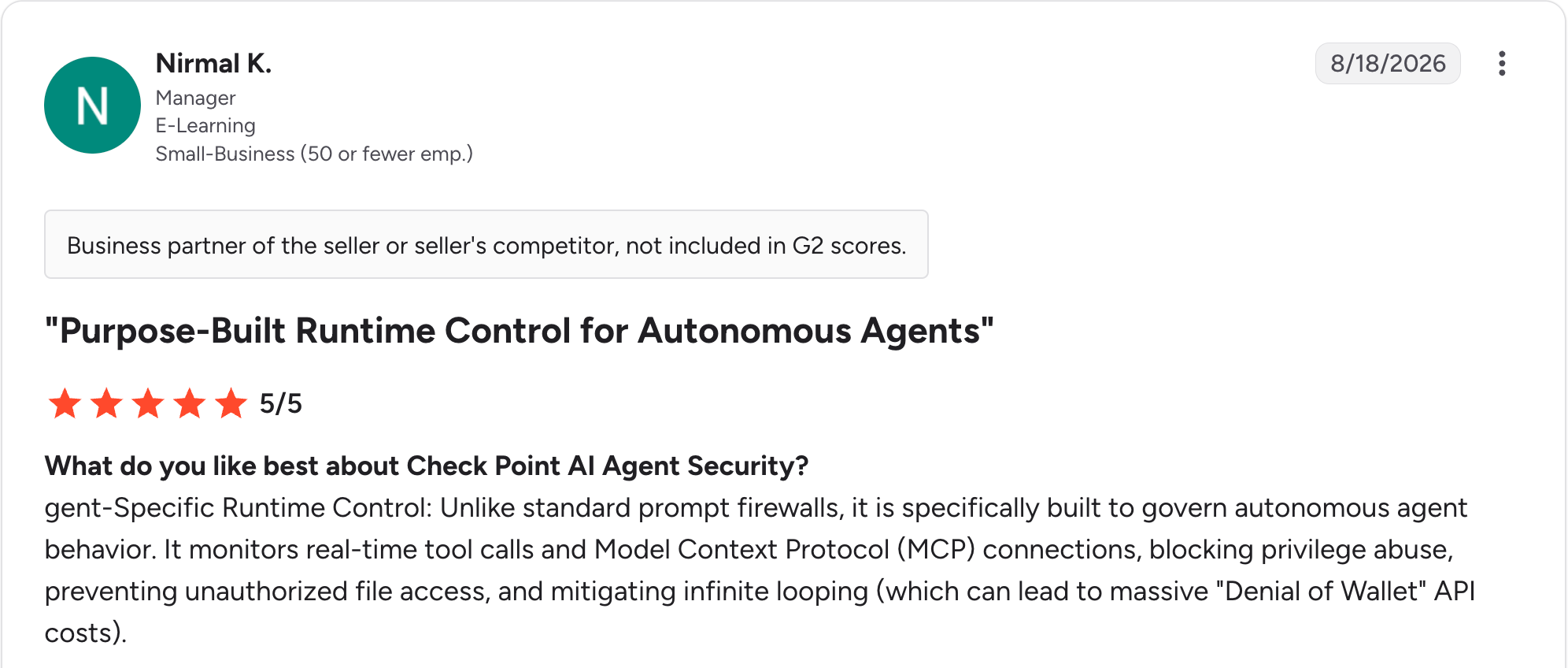
“It monitors real-time tool calls and Model Context Protocol (MCP) connections, blocking privilege abuse, preventing unauthorized file access, and mitigating infinite looping.” Nirmal K, G2

“The main area I’d improve is the complexity of setup and integration.” Lokesh G, G2
Pricing
Lakera is custom-priced, quote-based enterprise pricing sold through Check Point.
See the Lakera pricing page.
Bottom line
Lakera's detection technology is still a strong pick for prompt injection specifically. Evaluate it as part of a Check Point purchase, not a standalone startup relationship.
2. CalypsoAI (F5)
What it does: CalypsoAI combines runtime defense with agentic red-teaming and continuous observability, testing, and protection for models, agents, and applications against prompt injection, jailbreaks, and adversarial attacks on a single platform.
Best for: Enterprises that want both offense and defense from a single vendor, now as part of F5's application delivery stack.
F5 announced its intent to acquire CalypsoAI in September 2025 for $180 million in agreed consideration. The deal closed later that month, and F5's own SEC filing puts the final acquisition price at $145.2 million.
F5 is integrating CalypsoAI's inference-layer defenses into its Application Delivery and Security Platform, so it's evaluated today as an F5 capability rather than a standalone purchase from CalypsoAI.
Key features
- Agentic red-teaming: Automated adversarial testing against production AI systems.
- Runtime defense: Real-time blocking of prompt injection and unsafe outputs.
- Continuous observability: Ongoing monitoring layered on top of point-in-time tests.
Pros
- Combines red-teaming and runtime defense in one platform.
- SIEM and SOAR integration for existing security workflows.
- Now backed by F5's application delivery scale and distribution.
Cons
- No longer sold as a standalone company, so budgeting now runs through F5, not a direct CalypsoAI deal.
- Enterprise pricing only; contact sales required.
What users say
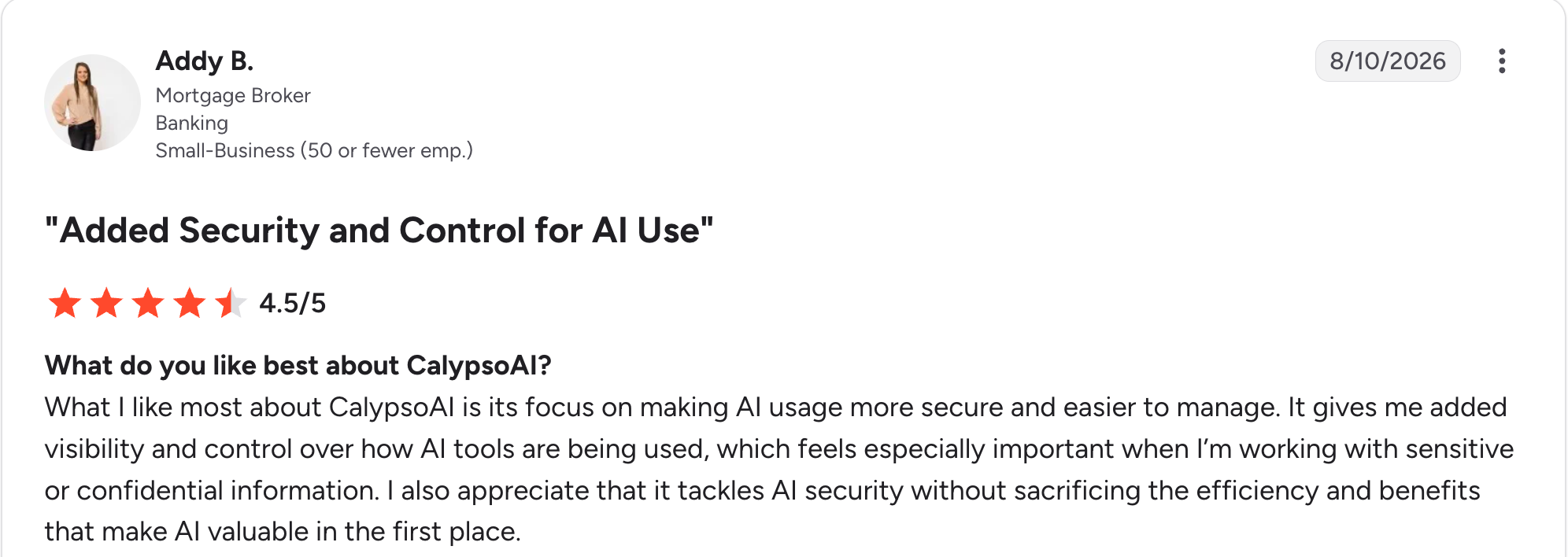
“What I like most about CalypsoAI is its focus on making AI usage more secure and easier to manage.” Addy B, G2

“One drawback is that CalypsoAI can have a steeper learning curve due to its enterprise-focused features and governance capabilities.” Sk C, G2
Pricing
CalypsoAI is custom, quote-based enterprise licensing.
Bottom line
CalypsoAI's combined red-teaming and runtime protection still make sense as a package, priced and supported through F5 rather than as a standalone vendor relationship.
3. HiddenLayer
What it does: HiddenLayer scans model files across 35-plus formats for backdoors and serialization exploits, discovers AI assets, and runs adversarial testing.
It's focused on the model and supply-chain layer, a different job from prompt-level defense.
Best for: Teams whose biggest AI risk is the model supply chain, third-party model files, fine-tunes, and registries, over chat-style prompt attacks.
That focus comes with a real gap. Prompt-level guardrails for conversational apps aren't the core strength, so pairing it with a runtime tool like Lakera covers that gap.
Key features
- Model file scanning: Detects backdoors and exploits across dozens of serialization formats.
- AI asset discovery: Inventories models in use across the organization.
- Adversarial testing: Flags inputs crafted to fool deployed models.
Pros
- Strong, specific coverage of model supply-chain risk.
- Works across classifiers and computer-vision models, well beyond LLMs alone.
- Established name in MLSecOps specifically.
Cons
- Prompt-level chat guardrails aren't its core strength.
- Enterprise-only, no public pricing listed.
What users say

“AI-specific risk visibility, the way it helps our security team structure controls, ensuring consistent internal approach to AI security.” Verified User, Gartner

“Documentation could be more detailed for advanced configuration.” Verified User, Gartner
Pricing
HiddenLayer is enterprise-only. Contact sales for a quote.
See the HiddenLayer pricing page.
Bottom line
HiddenLayer is the right call when model integrity and supply-chain risk are your central concern, paired with a runtime tool for prompt-level coverage.
4. Cisco AI Defense
What it does: Cisco AI Defense combines AI application validation, runtime protection, model assessment, and guardrails, delivered through Cisco's existing networking and security infrastructure.
It's built on the algorithmic red-teaming and validation technology from the company formerly known as Robust Intelligence, which Cisco acquired in October 2024.
Best for: Organizations already standardized on Cisco networking and security that want to add AI controls without deploying new agents.
Cisco emphasizes network-level visibility and enforcement, which simplifies adoption for Cisco-aligned environments. Network telemetry alone can miss application-level context that an in-process tool would catch.
Key features
- Network-level enforcement: AI controls delivered through existing Cisco security infrastructure.
- Algorithmic red-teaming: Inherited from Robust Intelligence's validation technology.
- Cisco Talos integration: Benefits from Cisco's broader threat intelligence.
Pros
- No new agents needed for Cisco-standardized environments.
- Backed by Cisco Talos threat intelligence and enterprise scale.
- Combines validation, runtime protection, and guardrails in one stack.
Cons
- Standalone Robust Intelligence is no longer sold; you're buying into the Cisco platform.
- Network-level inspection can miss internal application semantics a code-level tool would catch.
What users say

“The identification of "shadow AI" and the ability to create network-integrated security policies are its best features.” Verified User, Gartner

“It takes much more time to understand everything to learn all features.” Verified User, Gartner
Pricing
Cisco AI Defense is custom-priced, sold through Cisco agreements.
See Cisco AI Defense for details.
Bottom line
Cisco AI Defense fits enterprises already running Cisco security infrastructure who'd rather extend that stack than deploy a new standalone tool.
5. Palo Alto Prisma AIRS
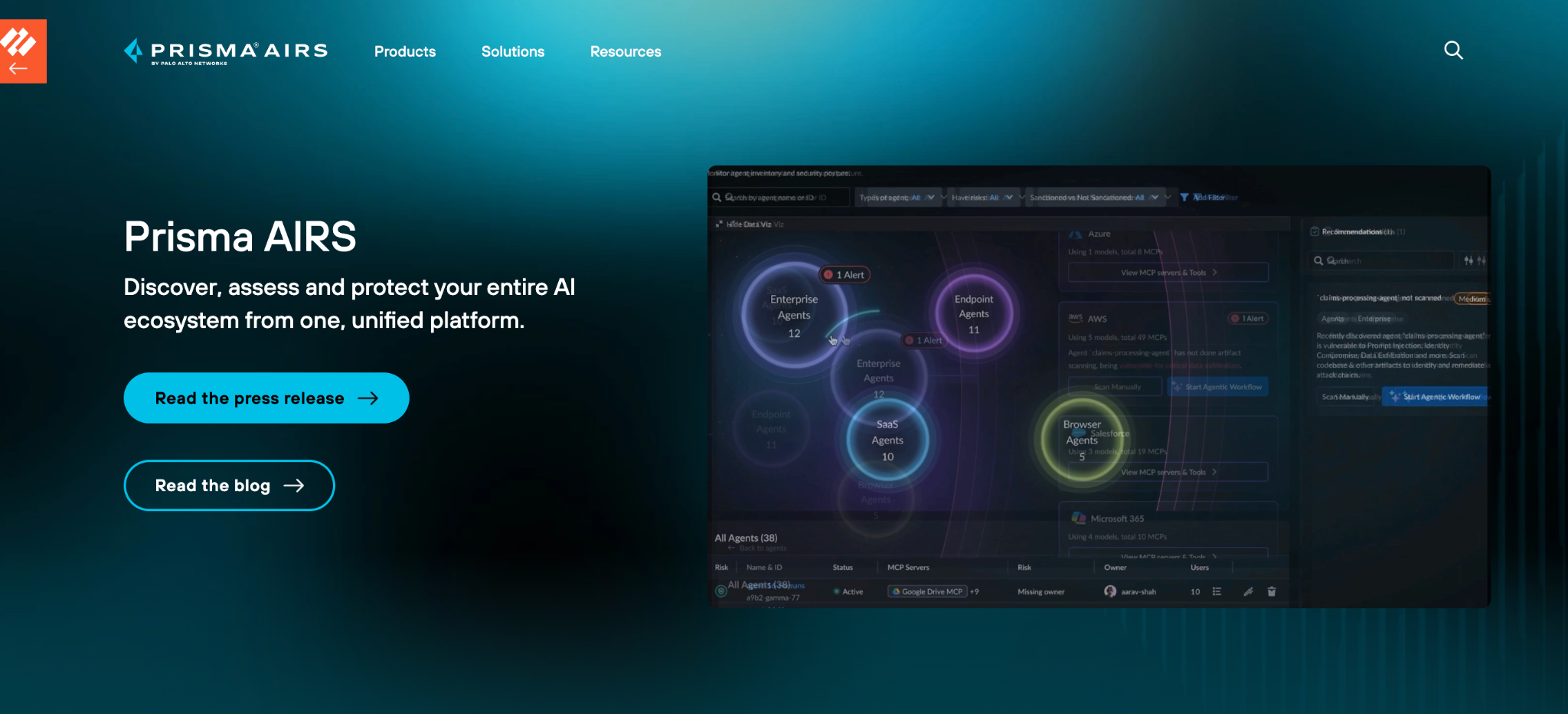
What it does: Prisma AIRS is Palo Alto Networks' AI security platform, built on the model-scanning and LLM Guard technology from Protect AI, which Palo Alto acquired in July 2025.
It covers AI-SPM discovery, model scanning, and runtime protection.
Best for: Organizations already standardized on Palo Alto Networks security products.
Like Cisco AI Defense, this is now a feature of a much larger security platform. Pricing and roadmap now follow Palo Alto's decisions, not a standalone vendor's.
Key features
- AI-SPM discovery: Inventories AI assets and models across the environment.
- Model scanning: Inherited from Protect AI's LLM Guard technology.
- Runtime protection: Guards deployed models and applications against attacks.
Pros
- Deep integration with Palo Alto's existing security portfolio.
- Inherits Protect AI's well-regarded model-scanning technology.
- Strong fit for large enterprises already on Palo Alto Networks.
Cons
- Protect AI is no longer available as an independent product.
- Full value depends on adoption of the Palo Alto platform.
What users say
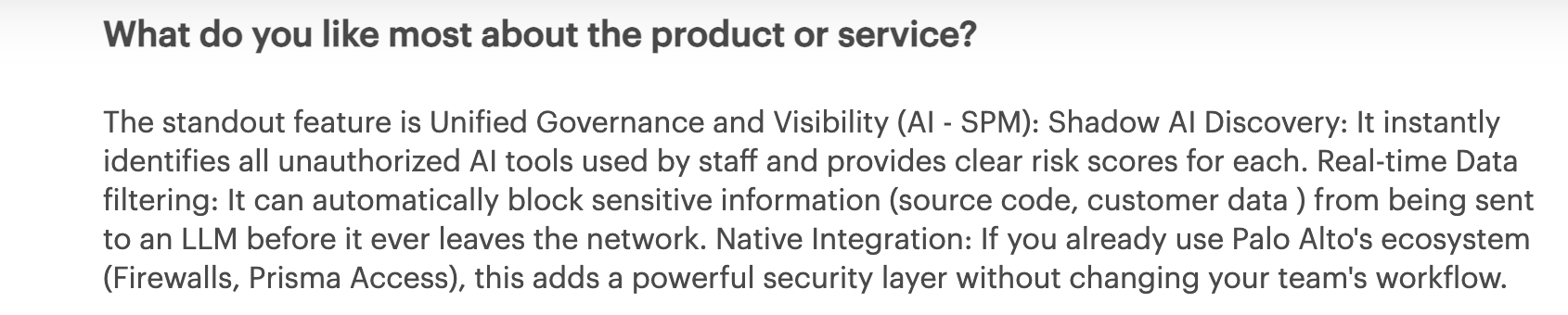
“The standout feature is Unified Governance and Visibility (AI - SPM).” Verified User, Gartner

“The biggest challenge is that some features still feel a bit early-stage or limited, so there’s a learning curve to understand how to get the most out of the platform.” Verified User, Gartner
Pricing
Prisma AIRS is custom-priced, sold through Palo Alto Networks.
See Prisma AIRS for details.
Bottom line
Prisma AIRS makes sense for Palo Alto customers looking to extend existing coverage to GenAI. It's a bigger commitment for teams starting from scratch.
6. Harmonic Security
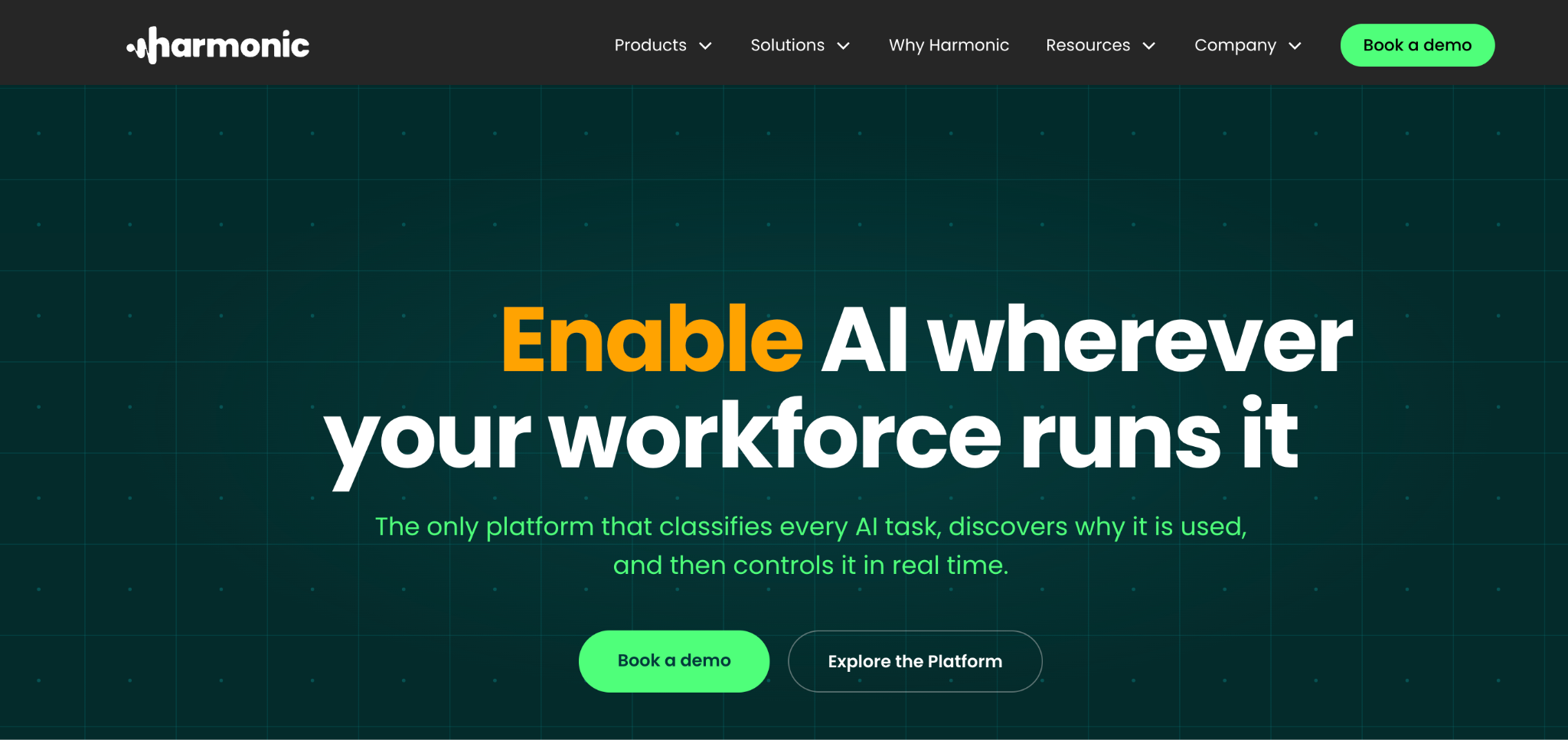
What it does: Harmonic Security analyzes GenAI activity in real time across browsers, desktop apps, and AI agents, using 25-plus proprietary small language models to detect sensitive data in prompts.
It enforces context-aware policies before that data leaves the organization.
Best for: Enterprises that want to enable broad employee AI adoption, ChatGPT, Claude, Copilot, and similar tools, with real-time coaching instead of blocking access outright.
Harmonic Security is independent, founded in 2023 and still standalone, while five other vendors here got folded into bigger platforms.
Key features
- Context-aware detection: Proprietary small language models analyze prompt intent and content instead of matching keywords alone.
- Shadow AI discovery: Surfaces every AI tool employees use across browsers, desktop apps, and agentic workflows, including MCP tool calls.
- Real-time coaching: Nudges users inline instead of blocking access outright, keeping workflows moving.
Pros
- Independent, full stop, with no acquisition or platform lock-in to weigh, unlike most other tools here.
- Strong review base backs it up, with 9 dated G2 reviews averaging 4.6 out of 5.
- Coaches instead of blocking, a differentiator reviewers call out directly.
Cons
- Browser-first coverage today, with desktop support still catching up per reviewer feedback.
- Enterprise pricing only; budgeting requires a sales conversation.
What users say
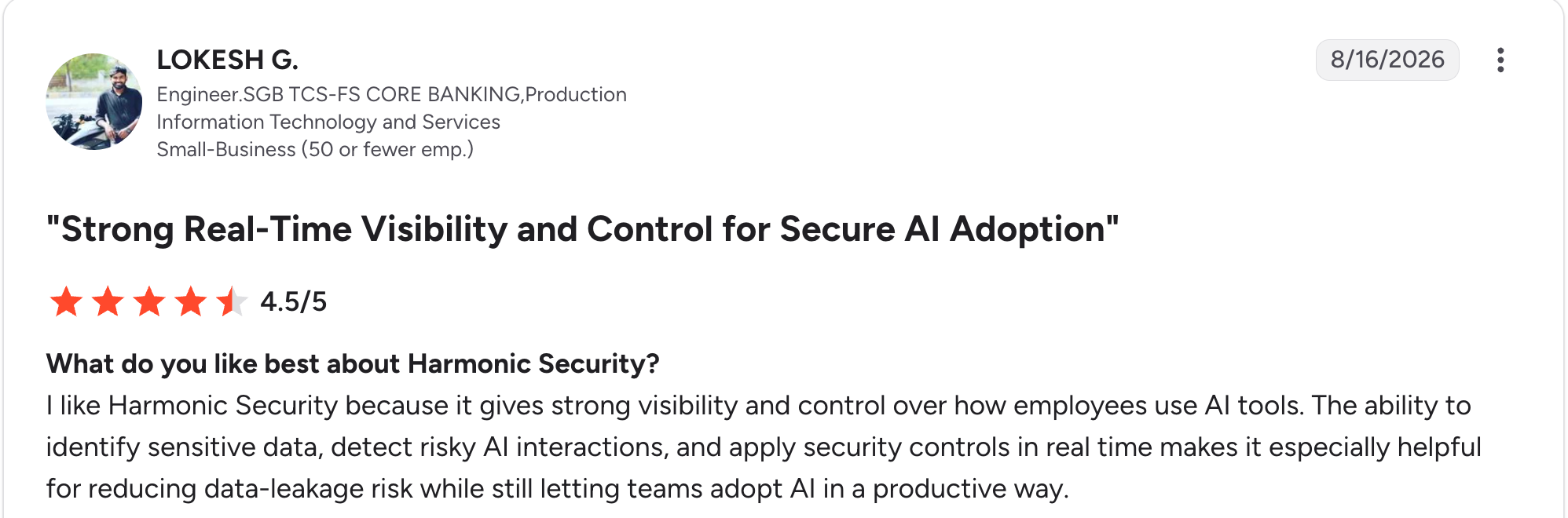
“I like Harmonic Security because it gives strong visibility and control over how employees use AI tools.” Lokesh G, G2

“I find the custom policy builder slightly complex for new admins, and I wish there were more detailed reporting templates for easier executive reporting.” Yousef M, G2
Pricing
Harmonic Security is custom, enterprise pricing with no published tiers. A live product preview is available with no signup or sales call.
See the Harmonic Security pricing page.
Bottom line
Harmonic Security is the pick when you want employee GenAI use to be secured through real-time coaching, backed by an independent vendor with a proven review track record.
7. Prompt Security (SentinelOne)
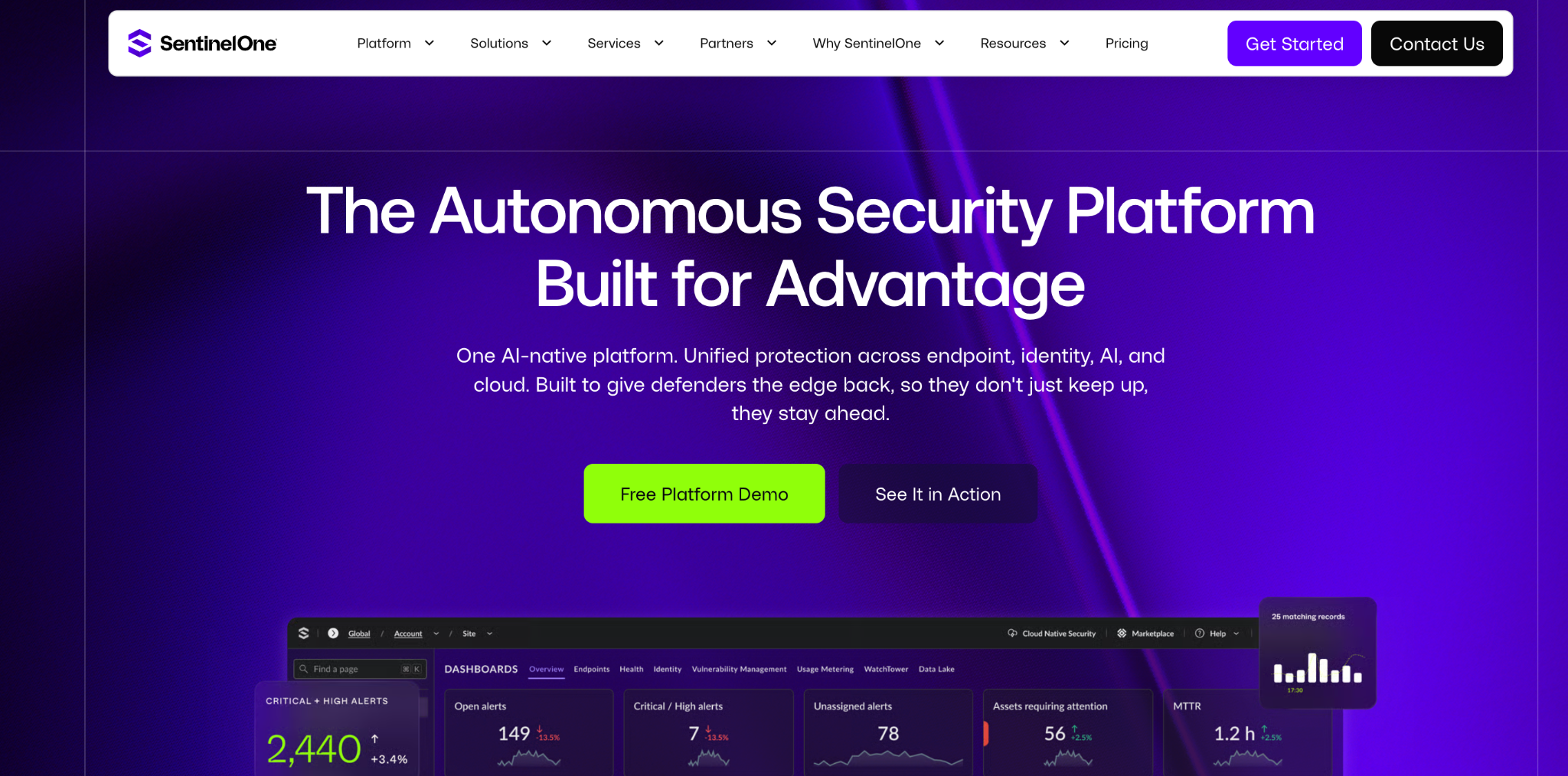
What it does: Prompt Security protects against prompt injection, data leakage, and shadow AI across both employee GenAI usage and homegrown LLM applications, via a secure gateway and browser-level integration.
SentinelOne signed a definitive agreement to acquire Prompt Security in August 2025, and Prompt Security now operates within the Singularity platform.
Best for: Organizations already running SentinelOne Singularity who want GenAI protection added to that platform.
The technology and team continue operating under the Prompt Security name, but the product is no longer sold as an independent company.
Key features
- Secure LLM gateway: Real-time detection of prompt injection and data leaks.
- Browser-level integration: Lightweight visibility into shadow AI use via browser extension.
- Flexible deployment: SaaS, on-premises, or browser extension depending on use case.
Pros
- Covers both employee AI usage and internally built LLM apps.
- Fast deployment via browser extension for initial visibility.
- Now backed by SentinelOne's broader platform and scale.
Cons
- No longer available as a standalone independent purchase.
- Full value tied to adopting the SentinelOne platform.
What users say
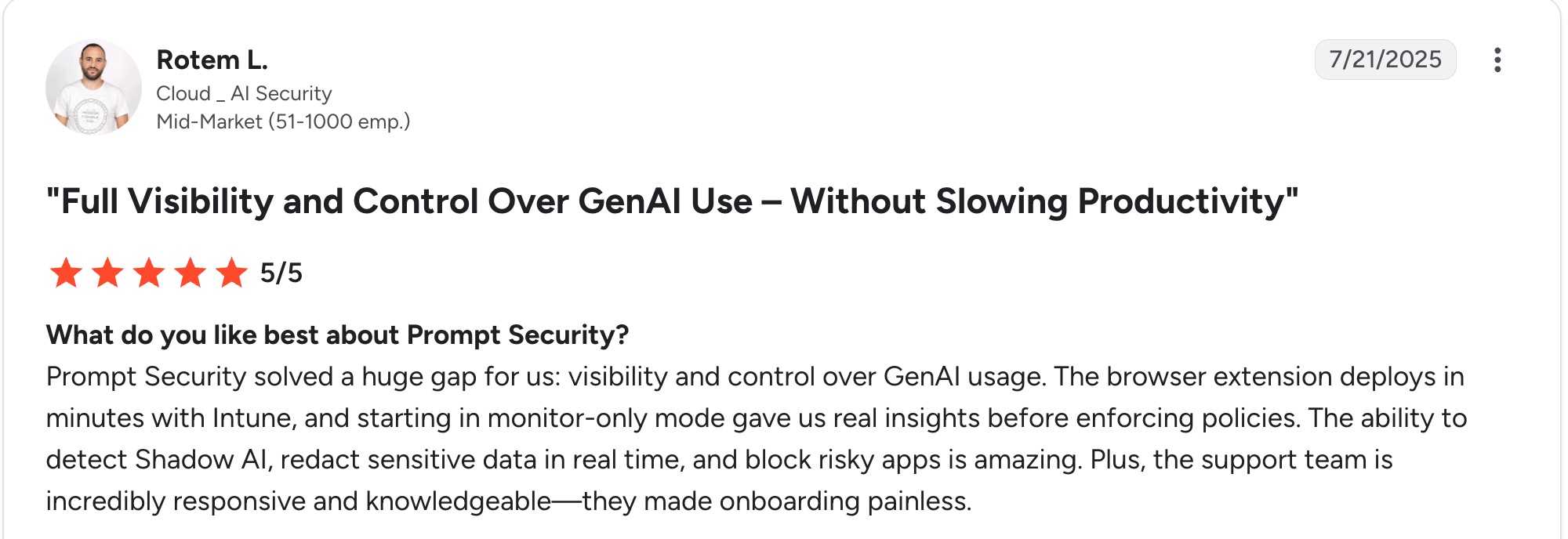
“Prompt Security solved a huge gap for us: visibility and control over GenAI usage.” Rotem L, G2

“The challenges lie in the rapidly changing market, which leads to the fast emergence of new needs.” Verified User, G2
Pricing
SentinelOne's Singularity platform starts at $179.99/endpoint/yr for Complete, with Commercial at $229.99/endpoint/yr and Enterprise custom-priced. Prompt Security's GenAI protection is bundled into that platform rather than priced as a standalone product.
See SentinelOne's pricing for details.
Bottom line
Prompt Security fits well if you're already on or considering SentinelOne. Weigh it inside that broader platform decision, not on its own.
8. Lasso Security
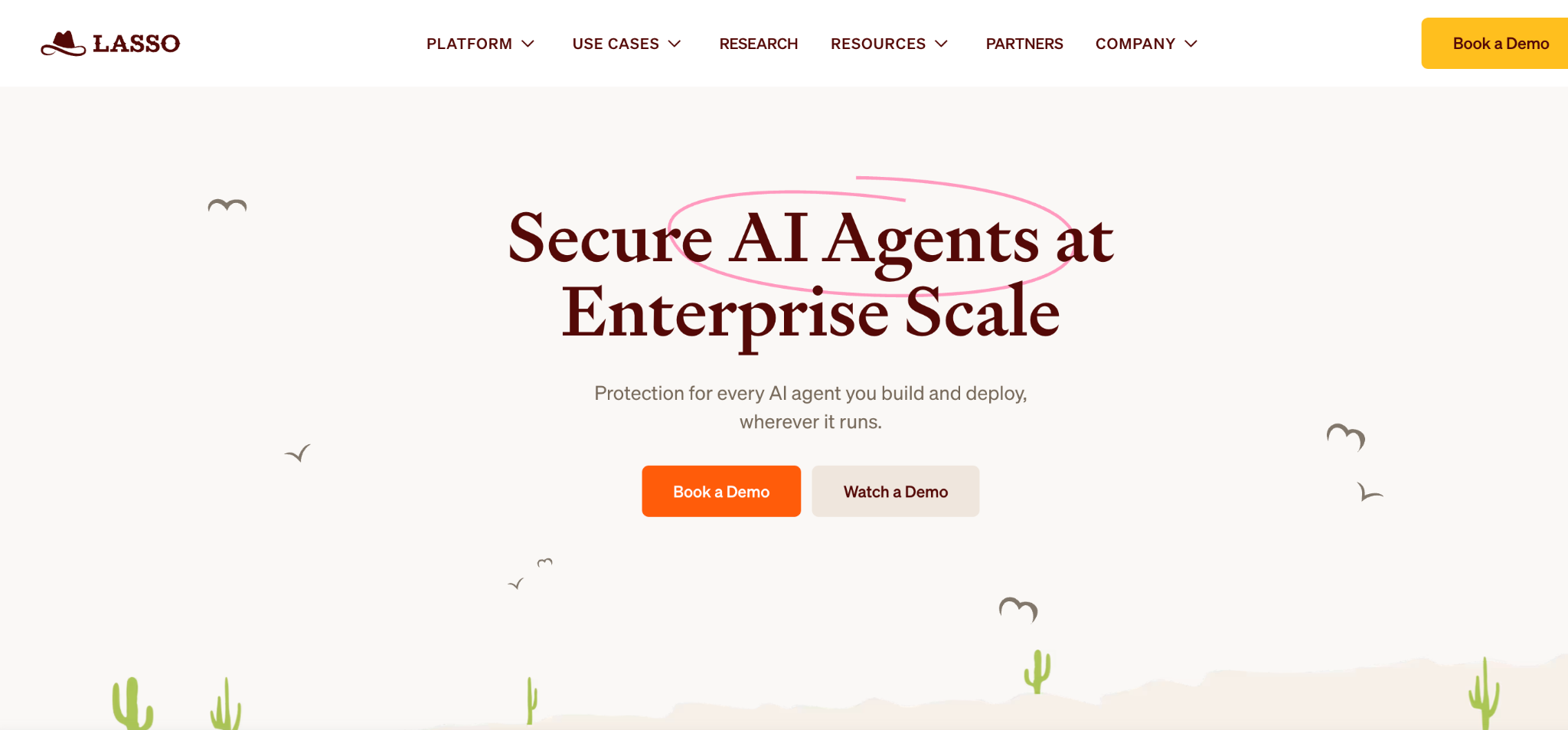
What it does: Lasso Security protects every LLM interaction across an organization, combining shadow AI discovery, autonomous LLM interaction monitoring, and real-time threat detection.
A red-teaming tool rounds out four solutions covering applications, employees, and developers.
Best for: Teams that want employee AI use and developer-built LLM applications protected under one policy framework.
Its scope is intentionally limited to generative AI interactions specifically, which keeps it focused compared to broader AI security suites.
Key features
- Four-part coverage: Separate solutions for applications, employees, developers, and red-teaming.
- Shadow AI discovery: Surfaces unauthorized LLM use across the organization.
- Autonomous monitoring: Tracks LLM interactions continuously, well beyond a single deployment check.
Pros
- Covers employee, developer, and application-layer risk together.
- Includes a dedicated red-teaming tool in the same suite.
- Focused scope avoids feature bloat.
Cons
- Newer, smaller vendor than the hyperscaler-backed options.
- Enterprise pricing only.
What users say

“Prompt proactive, which can block any prompt before it runs on the MCP according to my company policy.” Verified User, Gartner

“More visibility in terms of Cursor, OpenAI would be good.” Verified User, Gartner
Pricing
Lasso Security is custom, quote-based pricing.
See the Lasso Security pricing page.
Bottom line
Lasso Security is worth a look when you want employee AI use and developer-built LLM apps governed under a single, GenAI-specific vendor.
9. Cranium
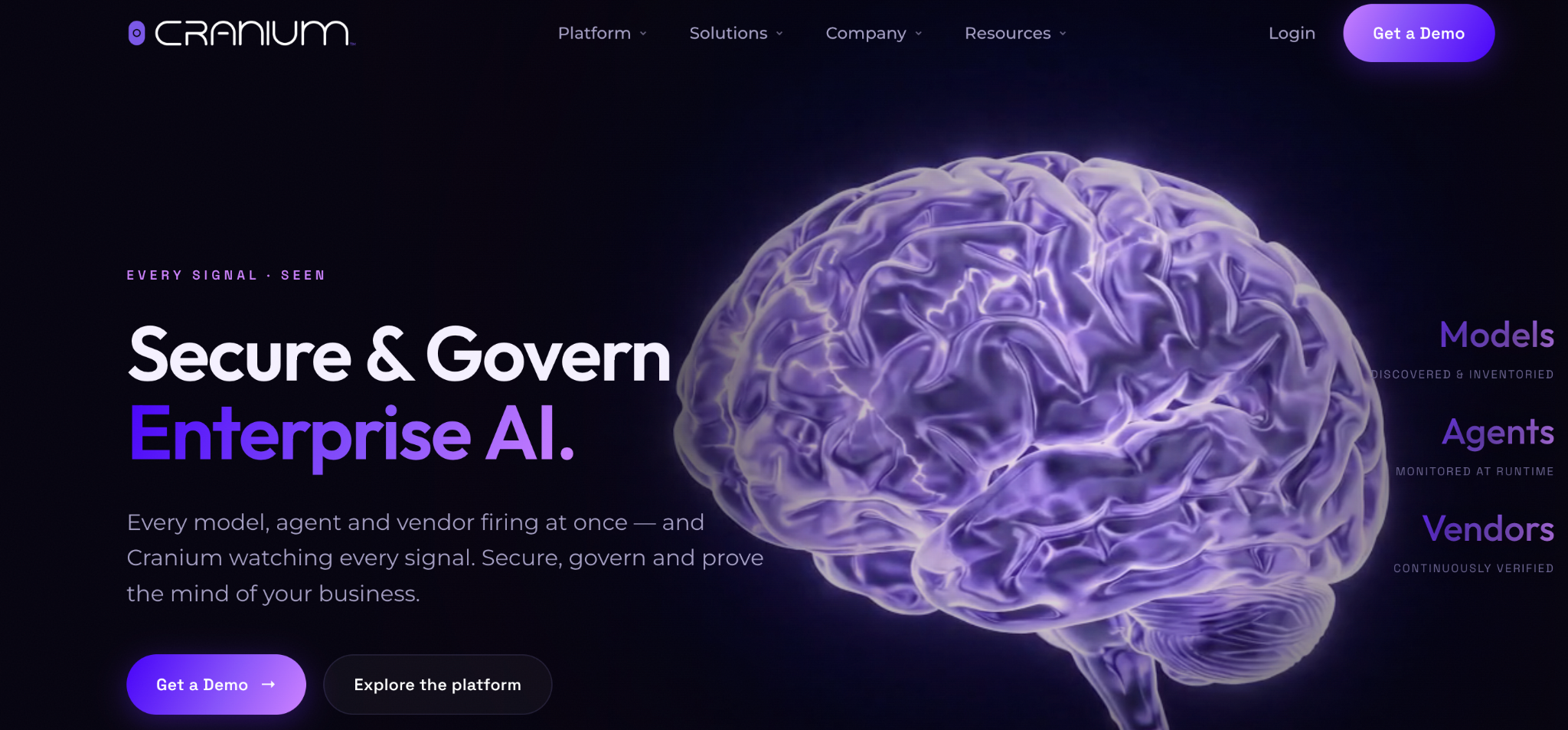
What it does: Cranium provides an AI governance and security platform that inventories, tests, and protects AI and ML ecosystems, with model documentation output similar to model cards for audit and compliance response.
Best for: Teams needing audit-grade evidence for EU AI Act or NIST AI RMF requirements alongside security testing.
It works best as the supply chain and inventory visibility layer, typically deployed alongside a runtime-focused tool like HiddenLayer or Lakera, rather than replacing one.
Key features
- AI asset catalog: Tracks lineage from training data through model versions to deployment.
- Standardized documentation: Generates model-card-style records for governance and audits.
- Risk classification: Ties inventory to compliance frameworks.
Pros
- Strong audit-evidence generation for EU AI Act and NIST AI RMF.
- Full lineage tracking from data through deployment.
- Complements runtime tools well, filling a gap they leave open.
Cons
- Not a runtime defense tool on its own.
- Enterprise pricing only; contact sales.
What users say

“Cranium has proved itself valuable in being a single pane of glass for AI security and risk visibility.” Verified User, Gartner

“This solution doesn't suit well for small companies.” Verified User, Gartner
Pricing
Cranium is custom, quote-based enterprise pricing.
See the Cranium pricing page.
Bottom line
Cranium is the pick when audit-ready AI inventory and documentation matter as much as they do in runtime defense.
10. Giskard
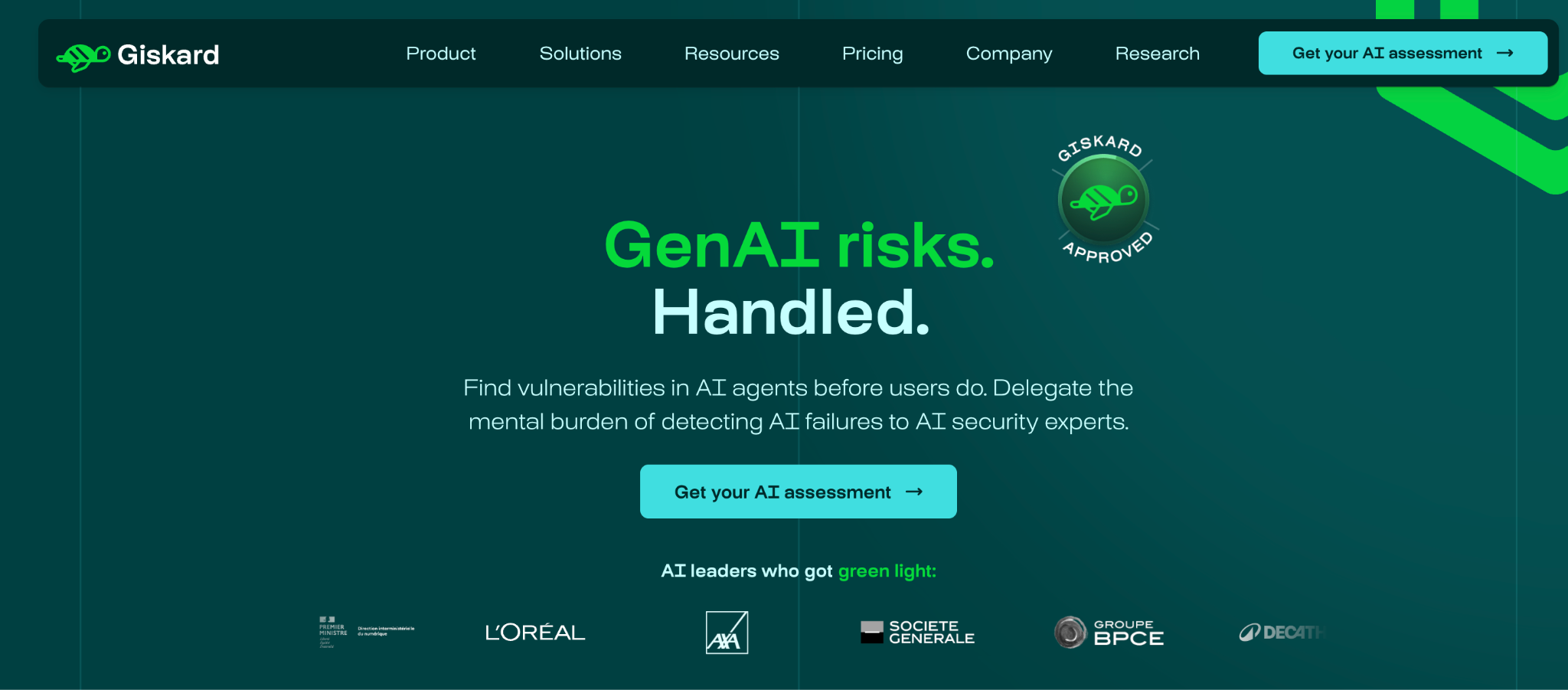
What it does: Giskard is an open-source Python library that automatically scans LLMs, RAG pipelines, and traditional ML models for vulnerabilities like prompt injection, hallucinations, and bias.
A RAGET toolkit specifically handles testing for RAG applications.
Best for: Developers who want free, code-level LLM and RAG testing before reaching for a paid platform.
The open-source SDK is complete for individual scans. Giskard Hub adds team collaboration and continuous red-teaming for organizations that outgrow solo use.
Key features
- RAGET toolkit: Auto-generates test questions and evaluates retrieval accuracy for RAG apps.
- Broad vulnerability scanning: Covers both LLM security and traditional ML quality issues.
- CI/CD integration: Runs scans on every commit.
Pros
- Free and open-source under Apache 2.0.
- RAG-specific testing that most competitors lack.
- Covers both security and quality issues (bias, hallucination) in one tool.
Cons
- Requires an LLM API key to power red-teaming agents, adding usage cost.
- Giskard Hub enterprise pricing isn't public.
What users say

“The interactive inspection feature that enables you to find issues in the data quality.” Verified User, Gartner

“A more ergonomic way to create data slices would have been great.” Verified User, Gartner
Pricing
Giskard's open-source library is free. Giskard Hub is custom, quote-based.
See Giskard's pricing.
Bottom line
Giskard is the strongest open-source pick for teams testing RAG applications specifically, with a real upgrade path if you need collaboration features later.
11. Promptfoo
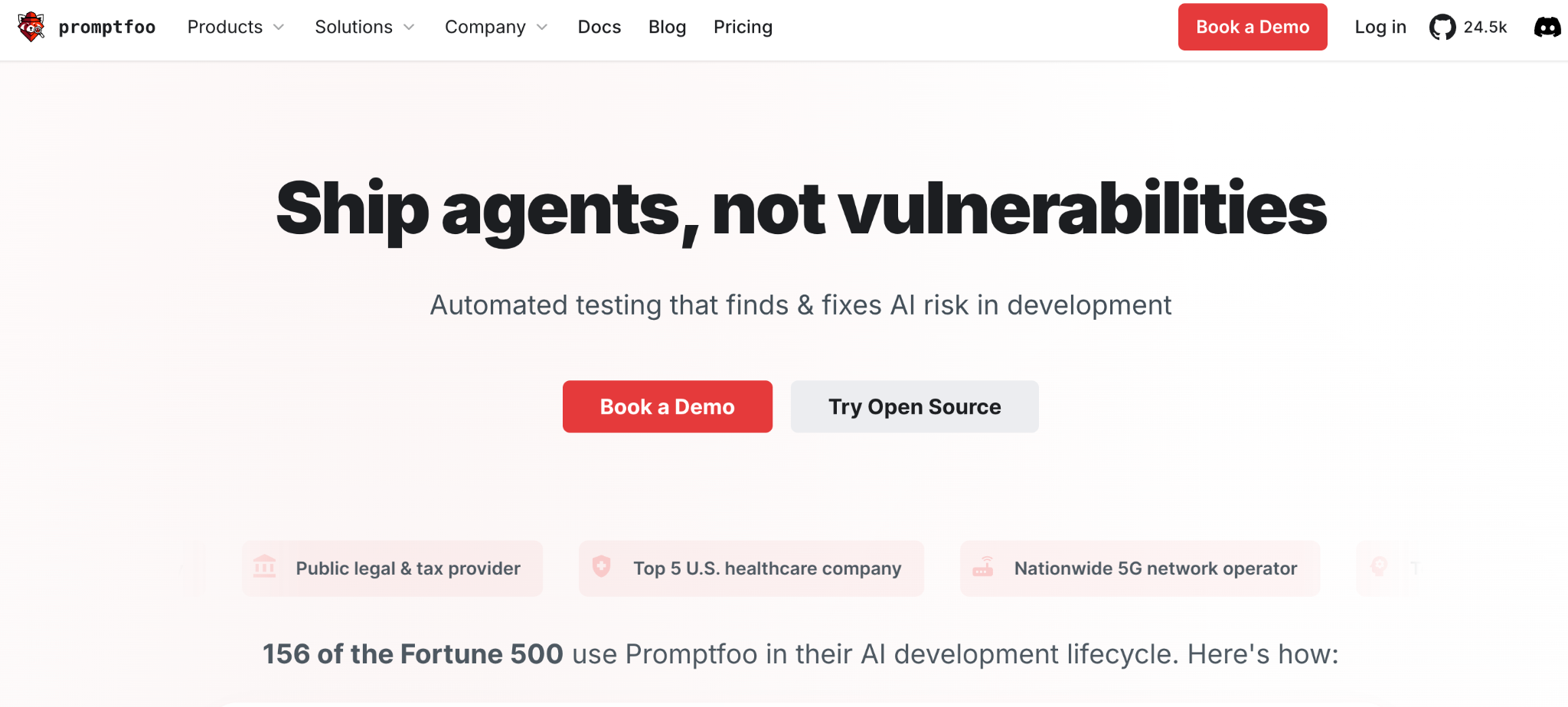
What it does: Promptfoo is an LLM evaluation framework with red-teaming as one capability, generating adversarial inputs to test for jailbreaks, prompt injection, and data leakage, configured through YAML and built for CI/CD pipelines.
Best for: Engineering teams that want red-teaming and prompt regression testing to run inside pull requests, as part of the normal workflow instead of a separate security review.
OpenAI announced its acquisition of Promptfoo in March 2026. The open-source project and cross-provider support continue unchanged for now, though some reviewers flag a fair, longer-term neutrality question worth watching.
Key features
- YAML-based evals: Declarative configuration that fits existing QA workflows.
- Red-teaming module: Automatically generates adversarial inputs.
- Broad provider support: Works with 60-plus providers, including Anthropic, Google, and local models.
Pros
- Free, open-source under MIT, with full features at no cost.
- Deep CI/CD integration for developer-centric teams.
- Provider-neutral in current practice.
Cons
- Now owned by OpenAI, which raises a fair long-term neutrality question.
- Quality-focused testing (hallucination, sycophancy) is less mature than its security coverage.
What users say

“Great. It does have 9k stars and production adoption by large-scale companies, but it’s great for sure.” Verified User, Reddit

“Promptfoo's red-teaming approach (probe generation + eval scoring) is the right direction.” Verified User, Reddit
Pricing
Promptfoo is free and open-source under the MIT license. The Team plan costs $50/month, with custom Enterprise pricing.
See Promptfoo's pricing.
Bottom line
Promptfoo is the best fit for developer-centric teams that want red-teaming inside their existing CI/CD workflow. The OpenAI acquisition is worth watching, though not a reason to avoid it today.
12. Garak
What it does: Garak is a free, open-source LLM vulnerability scanner from NVIDIA that runs adversarial probes across 50-plus attack modules to surface jailbreaks, prompt injection weaknesses, and other failure modes.
Best for: Developers who want a quick, no-cost first pass at probing a model's weaknesses before investing in a paid platform.
It's narrower in scope than Giskard or Promptfoo, focused specifically on probe-based vulnerability scanning, a narrower job than broader evaluation or CI/CD workflows.
Key features
- 50-plus attack modules: Wide library of adversarial probes out of the box.
- Command-line first: Runs quickly against any model with API access.
- Fully free: No paid tier or enterprise upsell.
Pros
- Completely free with no usage limits.
- Wide, actively maintained probe library.
- Fast to run for an initial vulnerability pass.
Cons
- No CI/CD integration or dashboard out of the box.
- Narrower scope than a full evaluation framework.
What users say

“If you're looking beyond simple jailbreaking, you should definitely check out Garak (an LLM vulnerability scanner).” Verified User, Reddit
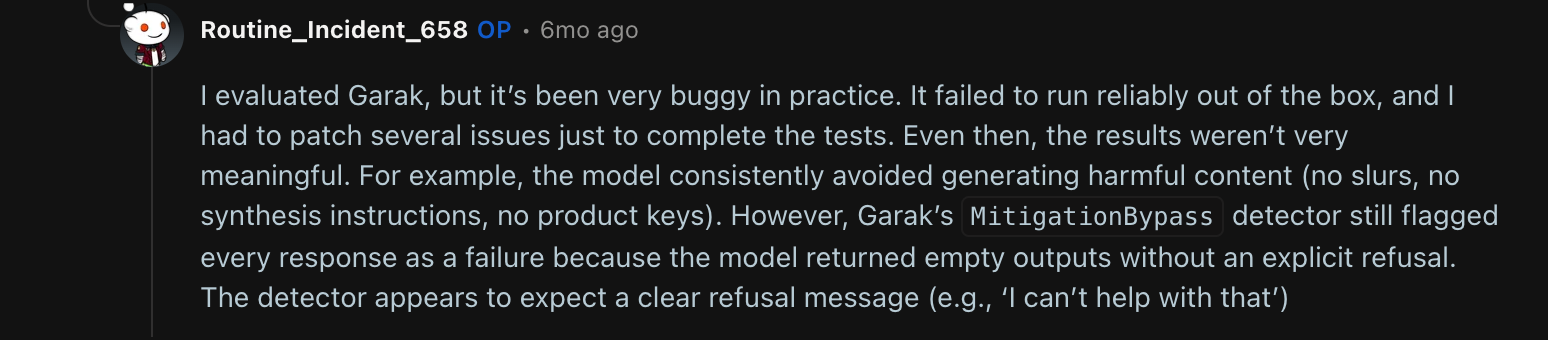
“It failed to run reliably out of the box, and I had to patch several issues just to complete the tests.” Verified User, Reddit
Pricing
Garak is free and open-source, with no paid tier.
See Garak on GitHub.
Bottom line
Garak is the fastest, cheapest way to get a first read on a model's vulnerabilities before committing to a paid tool.
13. NVIDIA NeMo Guardrails
What it does: NeMo Guardrails is a free, open-source framework for adding programmable guardrails to LLM applications, letting developers define rules that keep conversations on topic and block unsafe inputs or outputs.
Best for: Developers building an LLM application who want to add guardrails directly in code instead of routing traffic through a third-party proxy.
It's a framework you build with, so it fits teams comfortable owning the guardrail logic themselves.
Key features
- Programmable rails: Define custom rules for topic control and safety.
- Free and open-source: No cost, maintained by NVIDIA.
- Framework flexibility: Integrates into custom LLM application code directly.
Pros
- Completely free, backed by NVIDIA.
- Full control over guardrail logic in code.
- No vendor lock-in or proxy dependency.
Cons
- Requires real engineering effort to configure and keep up to date.
- No managed dashboard, alerting, or support included.
What users say
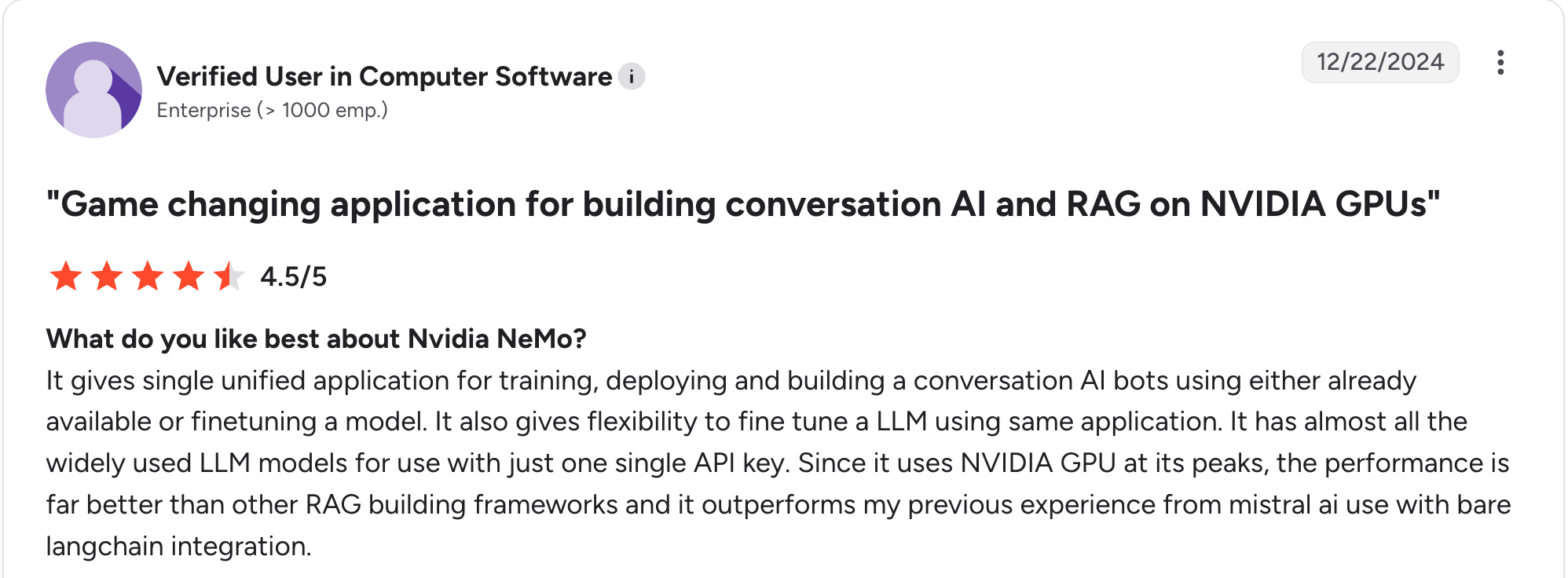
“It gives a single unified application for training, deploying, and building conversational AI bots using either an already available model or fine-tuning a model.” Verified User, G2

“It seems that if you are working in low-resource languages such as Vietnamese, you have to understand the workflow and modify it; this will make to utilize the pre-trained models.” Hoang V, G2
Pricing
NeMo Guardrails is free and open-source, with no paid tier.
See NeMo Guardrails on GitHub.
Bottom line
NeMo Guardrails suits engineering teams that want guardrails built into their own code over a managed third-party service.
Which generative AI security tool should you choose?
Discovery, runtime defense, and pre-deployment testing are different jobs, so plan on layering more than one of these tools together.
Choose Lakera, CalypsoAI, Harmonic Security, or Lasso Security if you:
- Need real-time runtime defense against prompt injection and leakage.
- Are comfortable evaluating a technology that's now backed by, or transitioning into, a larger platform. Lasso remains independently sold today.
Choose HiddenLayer or Cranium if you:
- Are most worried about model supply-chain risk or need audit-ready inventory.
- Want documentation for EU AI Act or NIST AI RMF compliance.
Choose Cisco AI Defense or Palo Alto Prisma AIRS if you:
- Already run Cisco or Palo Alto Networks security infrastructure.
- Prefer AI controls bolted onto what you already run, not a new vendor.
Choose Giskard, Promptfoo, or Garak if you:
- Want free or low-cost testing before committing to a paid platform.
- Have engineering resources to run and interpret the results yourselves.
Skip a dedicated vendor entirely if you:
- Only use a single hosted AI provider with built-in safety features and no custom prompts or fine-tuning.
Final verdict
If you're starting from scratch, HiddenLayer and Lasso Security are the two names here that remain independent, purpose-built vendors.
If model supply-chain risk or audit documentation is the priority, HiddenLayer and Cranium fill that gap.
If you're already standardized on Cisco, Palo Alto, SentinelOne, F5, or Cato, their AI security features are the path of least resistance, since you're likely paying for that capability soon anyway.
For teams that want to start free, Giskard, Promptfoo, and Garak cover real testing ground before any budget conversation is needed.
Where a security tool stops and app governance begins
Everything above secures what an LLM receives and outputs. A different problem shows up once teams start building internal applications with AI on top of that LLM.
Who governs what the app itself can access and do?
That's a separate layer these tools don't cover.
Superblocks is a governed enterprise vibe coding platform, built on a SOC 2- and HIPAA-aligned foundation, where internal AI-built apps run within IT-defined guardrails, with RBAC, audit logs, and access controls.
Shadow AI is the new shadow IT, and that governance layer is what keeps AI-built internal tools from becoming exactly that.
For the broader risk and governance picture this fits into, see our guides to AI risk management software and responsible AI tools.
To try governed app building for yourself, start with the Superblocks Quickstart Guide.
Or book a demo to see Clark AI generating governed apps in your own environment.
Frequently asked questions
What are generative AI security tools?
Generative AI security tools protect LLM applications against prompt injection, jailbreaks, and data leakage. They include runtime firewalls plus testing frameworks that probe for flaws before launch.
What is the best generative AI security tool?
The best generative AI security tool depends on your risk. HiddenLayer and Lasso Security lead among independent vendors; Lakera and CalypsoAI now come bundled with Check Point or F5, and Giskard or Promptfoo cover free testing.
Are HiddenLayer, Lakera, and similar tools still independent companies?
HiddenLayer, Lasso Security, and Harmonic Security remain independent as of 2026. Lakera, CalypsoAI, Prompt Security, Protect AI, and Robust Intelligence were all acquired between October 2024 and September 2025.
Is there a free generative AI security tool?
Yes, several generative AI security tools are free and open-source. Giskard, Promptfoo, Garak, and NVIDIA NeMo Guardrails cover LLM testing, red-teaming, and scanning, with no sales call required.
What is the difference between AI security tools and AI governance platforms?
The difference between AI security tools and AI governance platforms is scope. Security tools like Lakera defend LLM apps against attacks such as prompt injection in real time, while governance platforms manage policies across an organization.
At Virgin Voyages, non-technical teams now build their own AI apps, with IT governance fully intact. The result: 15+ production apps, seven departments onboard, and zero dedicated frontend engineers.
At Matthews, a marketing manager with zero coding background built an app that auto-generates offering memorandums, cutting turnaround from days to hours. See how the brokerage is putting AI builders on every team, with full governance intact.


Stay tuned for updates
Get the latest Superblocks news and internal tooling market insights.
Request early access
Step 1 of 2
Request early access
Step 2 of 2

You’ve been added to the waitlist!
Book a demo to skip the waitlist
Thank you for your interest!
A member of our team will be in touch soon to schedule a demo.
production apps built
days to build them
semi-technical builders
traditional developers
high-impact solutions shipped
training to get builders productive
SQL experience required
See the full Virgin Voyages customer story, including the apps they built and how their teams use them.

"Those tools are great for proof of concept. But they don't connect well to existing enterprise data sources, and they don't have the governance guardrails that IT requires for production use."
Table of Contents
%20(1).png)

Multiple authors
12 AI Agent Deployment Best Practices [2026]
AI agent deployment best practices that move an agent from offline evals to full traffic in stages, with scoped tools and a way to revoke it mid-task.
%20(1).png)
%20(1).png)