
AI model security protects machine learning models from unauthorized access, manipulation, or misuse that could compromise their integrity, confidentiality, or availability.
It covers the model itself, from training data through deployment, beyond the application built around it.
The stakes are real. In a 2025 case, a state-sponsored group jailbroke an AI agent to automate most of a cyberattack on its own. Here's what AI model security means, the core risks, and how to build it.
What is AI model security? The 30-second answer
AI model security is the practice of safeguarding model artifacts and controlling how models are trained, deployed, and queried.
It prevents attacks that alter a model's behavior, extract its proprietary information, or expose the data it was trained on.
Bottom line: It protects the model as an asset, distinct from securing the application or agent built on top of it.
Core risks
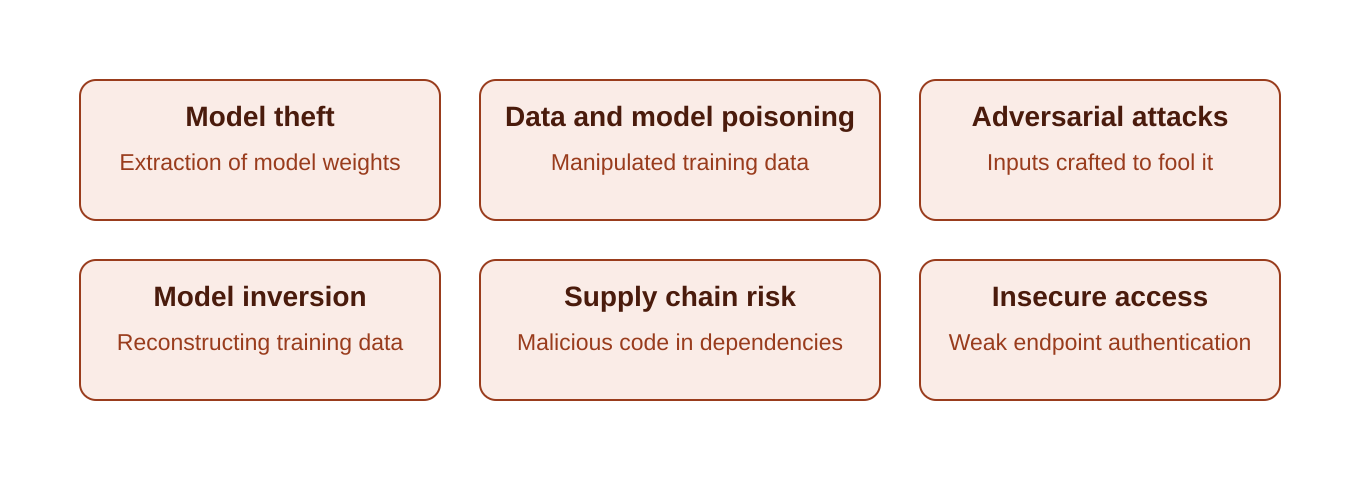
Here are the six risk categories:
- Model theft: Unauthorized copying or extraction of proprietary model weights, a growing concern specifically for closed frontier models.
- Data and model poisoning: Manipulated training or fine-tuning data that alters model behavior in ways hard to detect after deployment.
- Adversarial attacks: Inputs crafted to fool a model into misclassifying, leaking data, or bypassing its own safeguards.
- Model inversion and extraction: Techniques that reconstruct training data or replicate model behavior through repeated querying.
- Supply chain risk: Malicious code hidden in model files, dependencies, or third-party fine-tunes. Our AI model governance guide covers the policy side of tracking this.
- Insecure access and deployment: Weak authentication or permissioning on model endpoints, letting attackers query, extract, or misuse a model directly.
How does AI model security work?
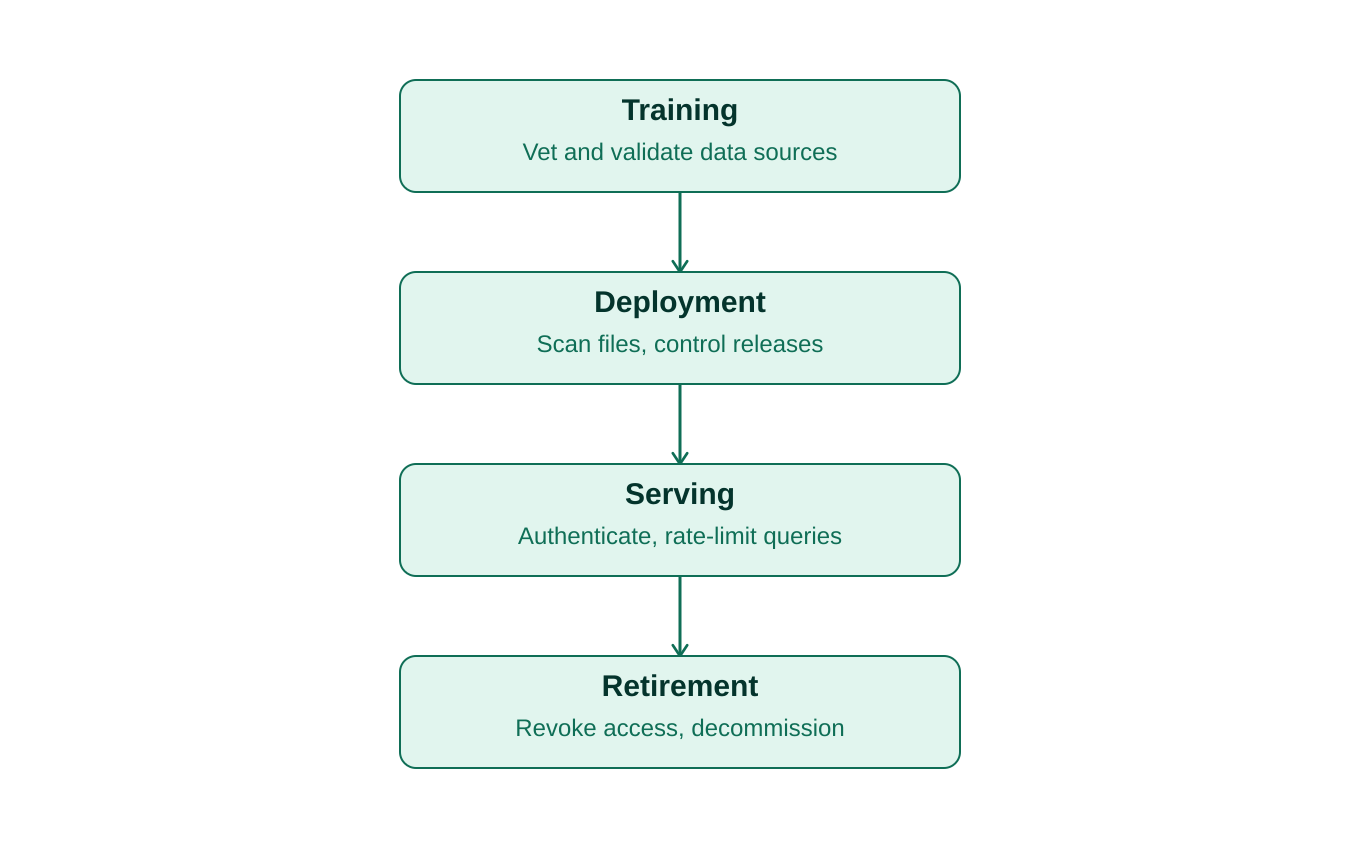
AI model security works by applying controls at each stage of a model's lifecycle, since risk enters differently at each point, from the data it trains on to how it's queried in production.
In practice, that spans four stages:
- Training: Vetting and validating data sources to prevent poisoning before a model ever ships.
- Deployment: Scanning model files and dependencies for tampering, and controlling who can deploy a new version.
- Serving: Authenticating and rate-limiting queries, monitoring for extraction attempts and adversarial inputs.
- Retirement: Securely decommissioning models and revoking access instead of leaving old endpoints live.
A real 2025 case shows what happens when this breaks down at the access layer.
Anthropic disclosed that a Chinese state-sponsored group jailbroke its Claude Code tool by breaking a cyberattack into small tasks, each one innocuous enough on its own to hide the larger malicious purpose.
The group then used it to automate 80 to 90% of an espionage campaign against roughly 30 organizations, succeeding in a handful of cases.
Anthropic detected, disrupted, and publicly disclosed the campaign itself, closer to the incident response this discipline is meant to produce than a simple failure.
AI model security vs. AI model governance: what's the difference?
The two are frequently confused, and the difference decides who owns which part of the problem.
Governance decides what's allowed and who owns it. Security enforces those decisions technically.
Our AI model governance guide covers the ownership side in depth.
What I liked and didn't like about AI model security in practice
Pros (what works)
Lifecycle thinking catches problems early. Teams that vet training data and scan model files before deployment prevent poisoning and supply chain attacks before they ever reach production, far cheaper than remediating them afterward.
Access control does most of the heavy lifting. Locking down who can query, deploy, or modify a model closes most realistic attack paths without requiring exotic defenses.
Cons (where it falls short)
Detection still lags reality. Indirect prompt-injection attacks grew roughly fivefold between March and May 2026, and detection tooling still struggles to reliably catch sophisticated attempts in real time.
Model weight theft is a real but hard-to-verify risk. RAND's research on securing frontier model weights found no confirmed public case of a closed model's weights being stolen as of its analysis.
Other breaches at frontier AI labs have occurred, though, so an unconfirmed case isn't the same as no risk.
Should you invest in AI model security? My take
If your organization trains, fine-tunes, or deploys models beyond calling a single hosted API with no custom data, model-level security controls are worth building deliberately, not something to assume the platform handles.
AI model security is essential for:
- Teams training or fine-tuning models on proprietary or sensitive data.
- Organizations deploying agentic systems with real permissions and access to tools.
- Anyone whose models sit behind public or semi-public endpoints.
You can move more gradually if you:
- Only call a single hosted model API with no fine-tuning or custom data.
- Keep sensitive data well away from your AI systems.
Our AI risk management guide covers how to prioritize these investments against your broader risk picture.
How to implement AI model security in 6 steps
Rolling this out works best as a sequence that builds from visibility to enforcement:
- Inventory your models. Know every model in production, including fine-tunes and third-party models, before deciding what to protect first.
- Vet training and fine-tuning data. Validate data sources and scan for anomalies before they become part of a model's behavior. Our data governance for AI guide covers this in depth.
- Scan model files and dependencies. Treat model artifacts like any other software supply chain component that needs verification before deployment.
- Lock down access. Apply authentication, rate limits, and least-privilege access to every model endpoint.
- Monitor for adversarial activity. Watch for extraction patterns, unusual query volumes, and inputs designed to probe model behavior.
- Plan for retirement. Revoke access and decommission old model versions instead of leaving unused endpoints reachable.
Pro tip: Start with access control on your highest-value models. It's the single control most incidents in this space have in common.
AI model security best practices
A few habits separate programs that hold up from ones that get bypassed:
- Treat model endpoints as privileged systems: A model with broad data access or tool permissions deserves the same scrutiny as a production database.
- Assume shadow models exist: Teams fine-tune and deploy models outside sanctioned channels, and those models stay invisible without deliberate discovery. Our shadow AI detection guide covers how to find them.
- Log everything a model does, beyond what it outputs: Understanding why a model took an action matters as much as the action itself once something goes wrong.
My verdict on AI model security
AI model security earns its place as a distinct discipline because the model is a different kind of asset.
It's trained on data that can be poisoned; it can be queried to reveal what it knows, and, increasingly, it can be manipulated into taking autonomous action.
The Anthropic disclosure is worth studying regardless of which vendor's model you run.
The attack succeeded by decomposing malicious intent into steps too small for the model to recognize, a pattern that access controls and monitoring can catch even when the model itself gets fooled.
Where Superblocks fits
Most AI model security tooling protects the models themselves, whether purchased, trained, or fine-tuned. It has limited visibility into the internal applications and agents business teams build with AI directly, on top of those models.
Superblocks is the governed enterprise vibe coding platform, built on a SOC 2 and HIPAA-aligned foundation, where those apps run inside guardrails from the start.
Every app, builder, and integration is queryable through the Superblocks MCP. Role-based access comes standard, while full audit logging is reserved for the Enterprise tier.
Shadow AI is the new shadow IT, and none of this model-level protection matters without visibility into what's built on top of it.
For example, Matthews Real Estate uses Superblocks so business teams can ship internal apps while IT keeps full visibility. Their VP of Product Innovation, Ryan Casey, put it plainly: "We don't have any shadow IT work happening".
For the LLM-application layer specifically, see our guide to enterprise LLM security.
To try governed app building for yourself, start with the Superblocks Quickstart Guide.
Or book a demo to see Clark AI generating governed apps in your own environment.
Frequently asked questions
What is AI model security?
AI model security protects machine learning models from unauthorized access, manipulation, or misuse across their lifecycle. It covers training data integrity, model file security, and access control on deployed models.
What is the biggest risk in AI model security?
The biggest emerging risk in AI model security is models being manipulated into taking harmful autonomous action. Anthropic disclosed a 2025 case of this exact pattern.
What is the difference between AI model security and AI model governance?
AI model security covers the technical controls that protect a model from attack, like access control and monitoring. Governance covers the policy side: ownership, documentation, and approval workflows.
What tool secures the internal apps built on top of AI models?
Superblocks builds role-based access and scoped data access into every internal app as it's created, with audit logs exportable on the Enterprise tier. For the underlying models themselves, a dedicated model security platform is still the right tool.
How do you protect AI models from theft?
You protect AI models from theft primarily through access control. Authenticate every request, rate-limit queries to slow extraction, and monitor for unusual query patterns. Encrypting weights at rest adds another layer.
At Virgin Voyages, non-technical teams now build their own AI apps, with IT governance fully intact. The result: 15+ production apps, seven departments onboard, and zero dedicated frontend engineers.
At Matthews, a marketing manager with zero coding background built an app that auto-generates offering memorandums, cutting turnaround from days to hours. See how the brokerage is putting AI builders on every team, with full governance intact.


Stay tuned for updates
Get the latest Superblocks news and internal tooling market insights.
Request early access
Step 1 of 2
Request early access
Step 2 of 2

You’ve been added to the waitlist!
Book a demo to skip the waitlist
Thank you for your interest!
A member of our team will be in touch soon to schedule a demo.
production apps built
days to build them
semi-technical builders
traditional developers
high-impact solutions shipped
training to get builders productive
SQL experience required
See the full Virgin Voyages customer story, including the apps they built and how their teams use them.

"Those tools are great for proof of concept. But they don't connect well to existing enterprise data sources, and they don't have the governance guardrails that IT requires for production use."
Table of Contents
%20(1).avif)

Multiple authors
How to Detect Shadow AI: 7 Methods That Work (2026)
Your employees are using AI tools you never approved. Shadow AI detection helps you find unsanctioned AI, govern it safely, and prevent data leaks.
%20(1).png)
%20(1).png)