
Vibe coding has taken off. The fastest-moving companies are giving AI build tools to business teams and engineering teams alike, and both are producing real work with them.
Most of those tools are prototyping environments. [Replit, Lovable, Bolt, and v0](https://www.superblocks.com/blog/replit-alternatives) are cloud IDEs with an agent attached. Claude and Cursor run on a developer's machine. They all do the same job well, turning a paragraph of intent into a working application quickly.
None of them puts that application in front of 3,000 employees, on company data, inside the controls a security team already enforces.
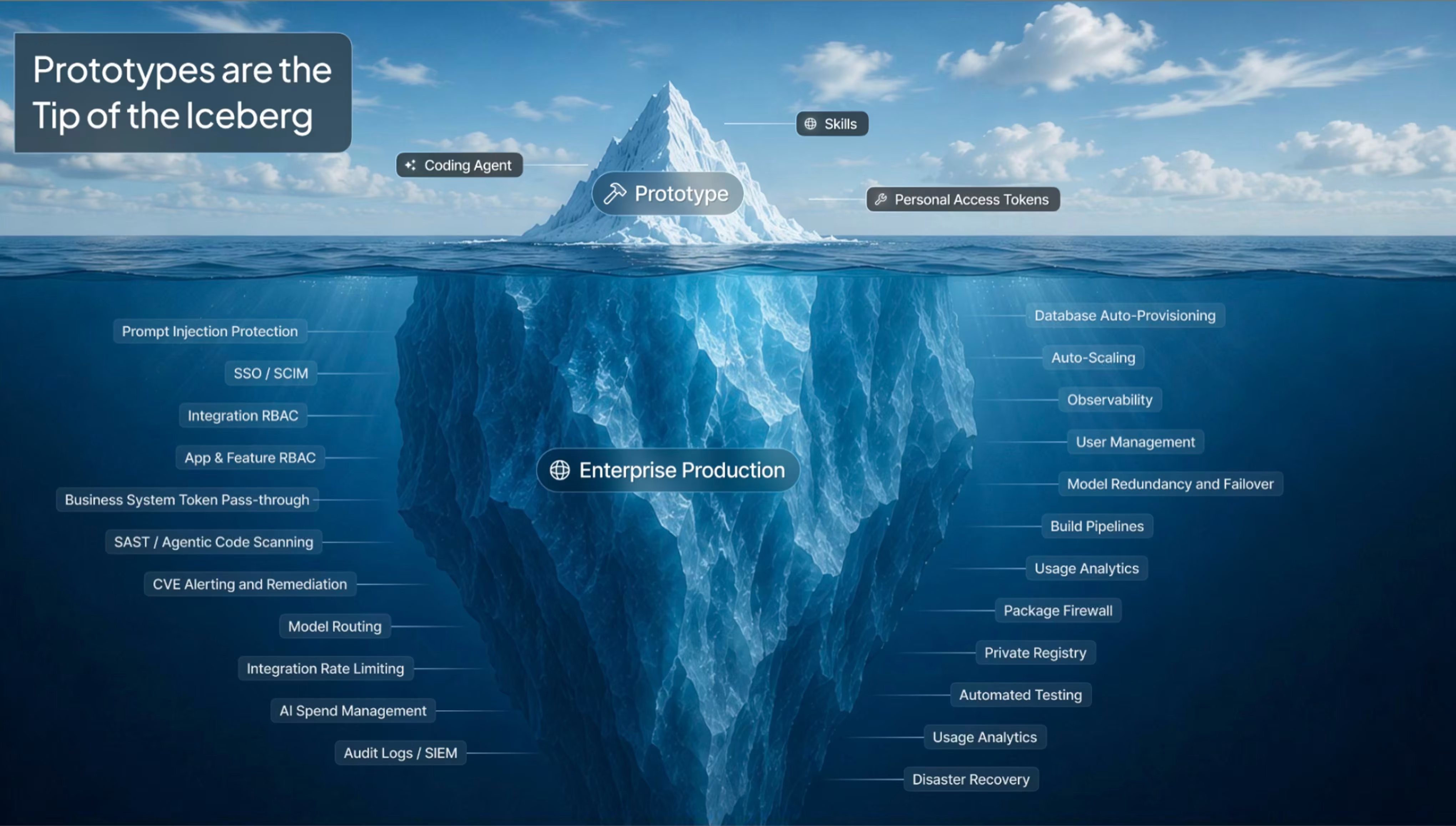
The image above shows both halves. Above the waterline are the three things a prototype needs: a coding agent, a set of skills, and a personal access token. Below it are the twenty-two an application needs before a company can run on it. Most tools are very good at the part above the line. Almost all of the effort, and almost all of the business impact, comes from the part below it.
Moving an AI prototype to production takes five things a prototyping tool does not provide: identity and access control, code and supply chain security, runtime infrastructure, model cost and availability controls, and an audit trail. That is twenty-two distinct capabilities, and each one used to be somebody's job. An identity admin approved access. A security reviewer read the code. A platform engineer provisioned the runtime. A cost owner watched the bill. An auditor answered for all of it.
Every app inherits the permissions you already set
Someone used to approve who could open an application and what data it reached. A prototype replaces that with a personal access token pasted into a config file, which works for one person in a demo.
Production needs SSO so people arrive with corporate credentials, and SCIM so they leave when HR says they left. Without SCIM, every app becomes another place a departed employee still has a working login.
Then permissions, which are three systems mistaken for one. App and feature RBAC governs who opens the app. Integration RBAC governs which data sources it reaches. Token pass-through governs what happens after it connects, so the app queries Snowflake or Salesforce as the person using it rather than as a service account with access to everything. Skip the third and the app enforces your permissions model on screen while bypassing it underneath. [The enterprise vibe coding playbook](https://www.superblocks.com/blog/the-enterprise-vibe-coding-playbook) covers how teams set this up.
Vulnerable code gets blocked before it ships
Someone used to read the code. They were slow, they were a bottleneck, and they caught things.
Now code arrives faster than any human reads. Veracode tested more than 100 models across 80 coding tasks in 2025 and found [45% of the generated code introduced an](https://www.veracode.com/blog/genai-code-security-report/) [OWASP Top 10](https://owasp.org/www-project-top-ten/) vulnerability. Veracode CTO Jens Wessling, on whether better models solve it: ["Larger models do not perform significantly better than smaller models, suggesting this is a systemic issue rather than an LLM scaling problem."](https://www.businesswire.com/news/home/20250730694951/en/AI-Generated-Code-Poses-Major-Security-Risks-in-Nearly-Half-of-All-Development-Tasks-Veracode-Research-Reveals)
So the review becomes part of the platform. Static scanners catch deterministic problems like SQL injection and hardcoded secrets. A swarm of security agents handles what a scanner cannot see, finding permission bypasses, business-logic flaws, and multi-step attack paths. Both run at publish, on every change.
The software supply chain is the other half, and the half most organizations have no answer for. A package firewall and a private registry decide what an agent can install. CVE alerting turns a newly disclosed vulnerability into a list of affected apps instead of a week of searching. Prompt injection protection keeps user input from becoming instructions, and automated testing catches what the next change breaks. [AI code governance tools](https://www.superblocks.com/blog/ai-code-governance-tools) covers the category in more depth.
Apps reach production without a platform team
Someone used to stand up the database, size the instance, wire the pipeline, and carry the pager. That work has to disappear into the platform, because a business-team builder does not know what an RPO is and should not need to.
Database auto-provisioning creates the backing store inside your own cloud. Auto-scaling absorbs the app that served 40 people in a pilot and now serves 4,000 at month-end close. Build pipelines keep deployment repeatable and reversible. Disaster recovery gives the app a recovery target the moment a business process depends on it.
Where it runs matters as much as that it runs. Superblocks 3.0 deploys inside the customer's own AWS virtual private cloud, so applications inherit existing IAM, networking, encryption, and audit policy. Code, data, and inference never leave the perimeter the security team already defends.
AI spend stays predictable as adoption grows
This layer has no predecessor. No role in the old lifecycle owned inference spend, because there was no inference.
Model routing sends planning to a frontier model and build work to cheaper open-source ones. Without it, token spend climbs in step with adoption, and the platform turns most expensive exactly when it starts working. Redundancy and failover keeps apps running when a provider rate-limits you. Rate limiting stops one polling loop from degrading Salesforce for everyone. Spend management attributes cost per team, per app, and per month.
IT can answer for every app in the organization
Someone used to answer the auditor. That person still exists, and now they answer for hundreds of applications nobody on their team wrote.
Audit logs record every build, query, integration access, and package install in a format the security team ingests directly, because evidence has to live where the rest of the evidence lives. Observability explains why an app is failing. Usage analytics shows which applications people open, which is how a portfolio gets pruned instead of accumulating.
Gartner expects [40% of enterprise applications to feature task-specific AI agents by the end of 2026, up from under 5% in 2025](https://www.gartner.com/en/newsroom/press-releases/2025-08-26-gartner-predicts-40-percent-of-enterprise-apps-will-feature-task-specific-ai-agents-by-2026-up-from-less-than-5-percent-in-2025).
The 22 layers between an AI prototype and production
Twenty-two layers, one platform
A capable platform team builds any single layer above. Twenty-two of them, each with an owner, a runbook, an on-call rotation, and maintenance that never reaches zero, is a different proposition.
Superblocks CEO Brad Menezes put the decision this way when Superblocks 3.0 shipped: "Until now, CISOs and CIOs had two choices: either shut down vibe code entirely and stifle AI business transformation, or let vibe coding run wild and risk a cyberattack." Shadow IT has never been easier to create or harder to control. The third option is a platform that carries all twenty-two layers so builders never see them.
A prototype tells you the idea works. Everything under the waterline tells you whether 3,000 people can use it without producing a breach, an audit finding, or a bill nobody predicted. [Read the Superblocks 3.0 launch](https://www.superblocks.com/blog/superblocks-3-0-secure-private-vibe-coding-on-aws-built-for-the-age-of-ai-cyberattacks) for how the platform delivers it, or [The Last Mile of Vibe Coding](https://www.superblocks.com/blog/the-last-mile-of-vibe-coding) for how governance fits together.
At Virgin Voyages, non-technical teams now build their own AI apps, with IT governance fully intact. The result: 15+ production apps, seven departments onboard, and zero dedicated frontend engineers.
At Matthews, a marketing manager with zero coding background built an app that auto-generates offering memorandums, cutting turnaround from days to hours. See how the brokerage is putting AI builders on every team, with full governance intact.


Stay tuned for updates
Get the latest Superblocks news and internal tooling market insights.
Request early access
Step 1 of 2
Request early access
Step 2 of 2

You’ve been added to the waitlist!
Book a demo to skip the waitlist
Thank you for your interest!
A member of our team will be in touch soon to schedule a demo.
production apps built
days to build them
semi-technical builders
traditional developers
high-impact solutions shipped
training to get builders productive
SQL experience required
See the full Virgin Voyages customer story, including the apps they built and how their teams use them.

"Those tools are great for proof of concept. But they don't connect well to existing enterprise data sources, and they don't have the governance guardrails that IT requires for production use."
Table of Contents
%20(1).png)

Multiple authors
AI Governance in Finance: The 2026 Compliance Guide
AI governance in finance keeps automated decisions auditable for regulators. See what it covers and which rules apply.
%20(1).png)
%20(1).png)