
Agentic AI governance challenges are the specific obstacles that make overseeing autonomous, tool-using AI systems harder than governing traditional AI models, from tracking what agents exist to understanding why they acted to applying rules written before agents could act on their own.
Governance hasn't caught up to the pace at which agents are being deployed.
Here's a look at the gaps, the rules trying to catch up, and what's starting to help close the distance.
Agentic AI governance challenges: the quick definition
The core challenge is that agentic AI acts, while most existing governance was built for AI that only responds, and the frameworks, audit logs, and regulations built for the earlier model don't transfer cleanly.
Bottom line: the technology moved to autonomous action faster than the tools and rules built to oversee it.
The core challenges
Six problems show up consistently across how organizations describe this gap.
Here they are:
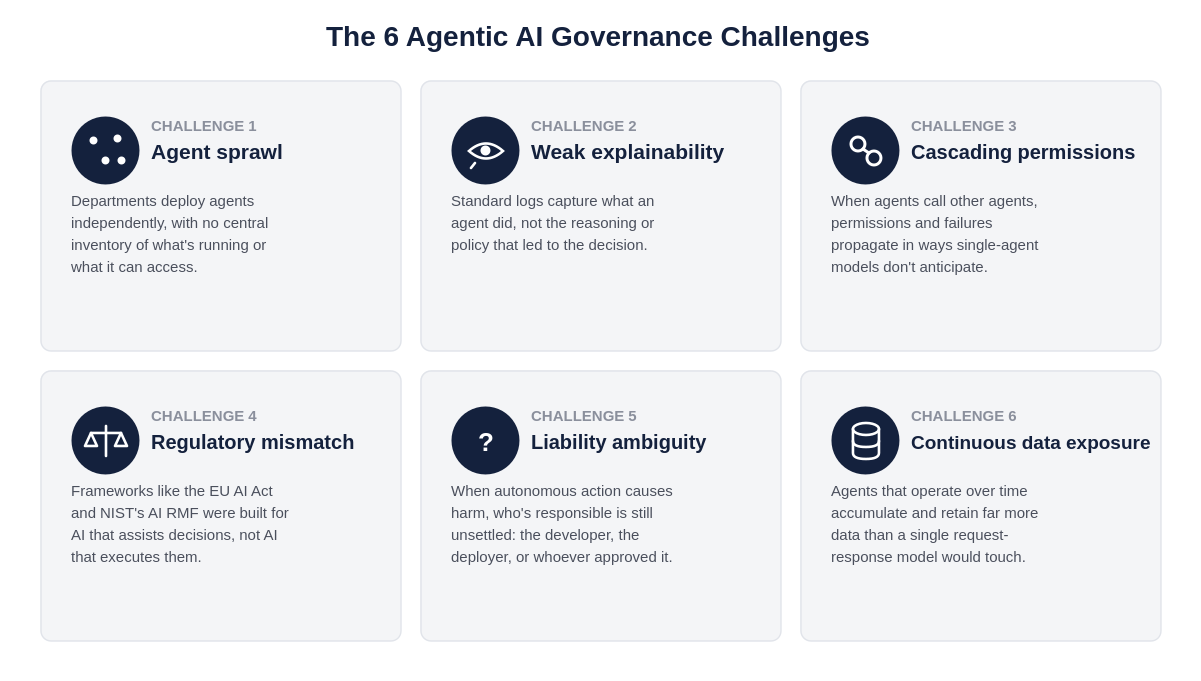
- Agent sprawl: Departments deploy agents independently, with no central inventory of what's running or what it can access.
- Weak explainability: Standard logs capture what an agent did, not the reasoning or policy behind the decision.
- Cascading permissions in multi-agent systems: When agents call other agents, permissions and failures propagate in ways single-agent governance models don't anticipate.
- Regulatory mismatch: Major frameworks like the EU AI Act and NIST's AI RMF were built around AI that assists human decisions, not AI that executes them independently.
- Liability ambiguity: When an autonomous action causes harm, who's responsible, the developer, the deploying organization, or whoever approved the agent, is still unsettled.
- Continuous data exposure: Agents that operate over time accumulate and retain far more sensitive data than a single request-response model would ever touch.
How do these challenges show up in practice?
They show up first in the deployment numbers. Gartner projects that 40% of enterprise applications will embed task-specific AI agents by the end of 2026, up from less than 5% at the start of the year, and one country has moved further than most to close the resulting governance gap.
The EU AI Act's risk categories assume a human makes the final call, with AI providing input. Agentic systems break that assumption by executing multi-step actions with no human in the loop at each step.
The Act's high-risk provisions were originally set to take effect in August 2026, but the EU pushed that deadline to December 2027 after acknowledging the compliance infrastructure organizations needed wasn't ready either.
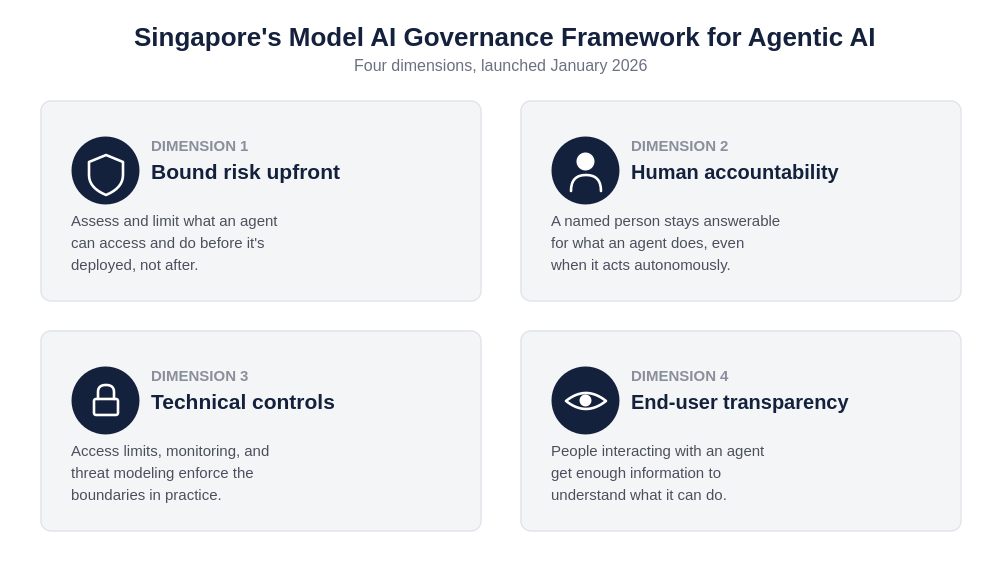
Singapore's response is the most concrete governance model built specifically for this gap. Its Infocomm Media Development Authority launched the Model AI Governance Framework for Agentic AI in January 2026, the first framework of its kind.
It's organized around four dimensions, from bounding risk before deployment and keeping a human accountable for outcomes to technical controls like access limits and monitoring, and giving end users enough information to understand what an agent can do.
It remains voluntary, and IMDA updated it in May 2026 based on feedback from more than 60 companies, incorporating lessons from real deployments in financial services and healthcare.
Agentic AI governance vs. traditional AI governance: what's the difference?
Traditional AI governance assumes a human reviews the output before anything happens. Agentic governance assumes the AI has already acted.
Here's how they compare:
Agentic governance has to assume something has already happened by the time a human sees it, which separates it from traditional AI governance with a few extra steps bolted on. Our guide to AI agent governance covers how to build a framework around that assumption.
What's working, and what isn't
Pros
Identity-first governance is gaining real traction. Singapore's framework and NIST's AI Agent Standards Initiative both converge on the same fix: giving every agent a traceable identity tied to an accountable human, instead of treating agents as generic service accounts.
The gap they're closing is real, since only 34% of organizations currently apply the same security controls to their AI agents that they apply to human employees.
Real-world case studies are starting to exist. Singapore's May 2026 update included documented deployments, like a bank using an agent to draft source-of-wealth memos with final approval still held by a human, showing governance and autonomy can coexist in a regulated setting.
Cons
Most guidance remains voluntary. Singapore's framework, like most current agentic-specific guidance, carries no binding legal force, so organizations that skip it face no direct penalty, only exposure if something goes wrong.
The multi-agent problem is largely unsolved. Governance models built for single agents don't yet have a mature answer for cascading failures across a chain of agents calling other agents.
The cost of getting this wrong is already showing up in project outcomes. Gartner predicts over 40% of agentic AI projects will be canceled by 2027, and inadequate risk controls are one of three reasons named, alongside escalating costs and unclear business value.
Does this apply to your organization?
If your organization has deployed even one agent with real tool access or the ability to act on production systems, these gaps already apply to you, whether or not you're calling it "agentic AI governance."
Addressing this is essential if you:
- Have agents with write access to production systems or customer data.
- Can't currently produce a full inventory of every agent operating in your environment.
- Operate in a jurisdiction with AI-specific regulation already in force.
You can move more gradually if you:
- Use agents strictly for internal, read-only, low-consequence tasks.
- Have only a handful of agents, each with a single known owner and narrow scope.
How to address agentic AI governance challenges in 6 steps
Closing this gap works best as a sequence that builds visibility before adding constraints.
Here's the sequence:
- Inventory every agent in operation. Agent sprawl is the starting problem, and you can't govern what you can't see. Our shadow AI agents guide covers finding agents deployed outside sanctioned channels.
- Assign a traceable identity to each agent. Tie every agent to a specific human owner instead of a shared service account.
- Bound risk before deployment, not after. Define what data and tools an agent can touch at the design stage, following Singapore's risk-bounding model.
- Log decisions alongside actions. Capture the reasoning and policy behind what an agent did, not just the action itself. Our AI audit trail guide covers what to log specifically.
- Map your regulatory exposure. Identify which frameworks, such as the EU AI Act, sector-specific rules, or emerging agentic-specific guidance, apply to your deployments.
- Plan for multi-agent complexity early. Don't wait until agents are calling other agents to think about how permissions and failures should propagate.
Pro tip: treat every new agent as a new hire, not just a new feature. It needs an owner, defined access, and a way to be shut off before it starts working.
Best practices for agentic AI governance
A few habits separate organizations closing this gap from ones falling further behind.
The habits:
- Give every agent a kill switch: An agent without a fast, reliable way to be disabled is a liability the moment something goes wrong. The EU AI Act's Article 14 already codifies this for high-risk systems, requiring a stop button or equivalent that brings the system to a safe halt.
- Treat identity as the foundation, not an add-on: Every other control, including access, logging, and accountability, depends on knowing exactly which agent did what.
- Revisit governance as autonomy increases: An agent that graduates from suggesting actions to executing them needs a new governance review, not a grandfathered policy.
Where this leaves you
The honest picture is that governance is playing catch-up to a technology that crossed from suggesting to acting faster than most organizations' oversight matured.
Singapore's framework is the clearest sign of what a real answer looks like, but it's voluntary, brand new, and still being tested against multi-agent complexity nobody has fully solved.
Waiting for binding regulation to force the issue is a bad bet. Organizations that address agent sprawl, identity, and audit trails now will find compliance easier whenever enforcement catches up, and carry far less risk in the meantime.
Where Superblocks fits
Most agentic AI governance guidance addresses agents built on top of purchased models and enterprise platforms. It has less to say about the agents and internal apps business teams build directly with AI, some of the least visible instances of agent sprawl in an organization.
Superblocks is the governed enterprise vibe coding platform, built on a SOC 2 and HIPAA-aligned foundation, where every AI-built app and agent gets a traceable identity from the moment it's created.
RBAC applies to every plan, and Enterprise adds audit logs and access control built in from the start instead of bolted on after deployment.
For the broader framework this fits into, see our guides to AI agent governance and AI governance generally, or our roundup of AI agent governance platforms for dedicated tooling.
See how a traceable identity gets built into every agent from the start with the Superblocks Quickstart Guide, which walks through building an agent with RBAC and audit logging already in place.
Or book a demo to see how Superblocks fits into your existing agent governance program.
Frequently asked questions
What are the main agentic AI governance challenges?
The main challenges are agent sprawl across departments, weak explainability in standard logs, and cascading permission risk in multi-agent systems. Add to that regulation built for AI that assists over AI that acts, unresolved liability when autonomous action causes harm, and continuous data exposure from long-running agents.
Why is agentic AI harder to govern than traditional AI?
Agentic AI is harder to govern because it takes autonomous, multi-step action instead of just generating output for review. Traditional governance assumes a human catches problems before they cause harm, while agentic systems may have already acted by the time anyone reviews what happened.
Is there a regulatory framework specifically for agentic AI?
Singapore's IMDA launched the first framework built specifically for agentic AI in January 2026, covering risk-bounding, human accountability, technical controls, and end-user transparency. It remains voluntary. Broader frameworks like the EU AI Act apply but weren't designed with autonomous action in mind.
What tool helps govern AI agents built inside a company?
For AI-built internal apps and agents, Superblocks assigns a traceable identity from creation, with RBAC on every plan and audit logs on Enterprise. Dedicated AI agent governance platforms remain right for agents built on purchased models and third-party platforms.
Who is liable when an AI agent causes harm autonomously?
Liability for autonomous AI agent harm remains unsettled, with responsibility potentially falling on the developer, the deploying organization, or whoever approved the deployment. This ambiguity is one of the most cited open problems in agentic AI governance.
At Virgin Voyages, non-technical teams now build their own AI apps, with IT governance fully intact. The result: 15+ production apps, seven departments onboard, and zero dedicated frontend engineers.
At Matthews, a marketing manager with zero coding background built an app that auto-generates offering memorandums, cutting turnaround from days to hours. See how the brokerage is putting AI builders on every team, with full governance intact.


Stay tuned for updates
Get the latest Superblocks news and internal tooling market insights.
Request early access
Step 1 of 2
Request early access
Step 2 of 2

You’ve been added to the waitlist!
Book a demo to skip the waitlist
Thank you for your interest!
A member of our team will be in touch soon to schedule a demo.
production apps built
days to build them
semi-technical builders
traditional developers
high-impact solutions shipped
training to get builders productive
SQL experience required
See the full Virgin Voyages customer story, including the apps they built and how their teams use them.

"Those tools are great for proof of concept. But they don't connect well to existing enterprise data sources, and they don't have the governance guardrails that IT requires for production use."
Table of Contents
.png)

Multiple authors
What Is AI Safety Policy and Governance? A 2026 Guide
AI safety policy and governance covers how nations and companies manage AI risk. Here's the global landscape, the frameworks, and what it means for you.
%20(1).png)
%20(1).png)