Deterministic AI guardrails are fixed rules, such as schemas, permissions, and allowlists, that check what an AI does and give the same verdict every time.
This guide covers seven types with examples, a worked agent request, and how to layer them with model-based checks in production.
What are deterministic AI guardrails? The 30-second answer
Deterministic AI guardrails are rule-based checks that sit around an AI model and decide what it may do. The same input always gets the same verdict, and a rule produces it without model judgment.
Bottom line: Deterministic guardrails limit what an AI can do, and probabilistic checks judge what it said. Use both, with the deterministic layer first.
The rules live outside the model. A prompt can change what an agent asks for, but it cannot change what a permission check allows.
Our guide to AI guardrails covers the wider category. This page narrows in on the deterministic part.
Key characteristics
Deterministic guardrails have four traits:
- Repeatable: The same input gets the same result, and you can test and audit each rule.
- Explainable: You can point to the rule that fired.
- Fast and cheap: Rule checks run without a model call.
- Narrow: A rule catches only what someone encoded, and it does not understand meaning.
A note on the word "deterministic"
MLflow calls its Guardrails AI scorers deterministic because they need no LLM call. Its write-up says each validator runs locally through NLP classifiers, regex patterns, or named entity recognition.
The same write-up admits minor non-determinism across hardware in its BERT-based jailbreak scorer, because of floating-point precision.
A regex that matches a card number is deterministic in the strict sense. A toxicity classifier is statistical, with a score and a threshold.
This page uses the strict meaning of rules whose verdicts do not depend on a model's judgment.
Deterministic vs. probabilistic guardrails: what's the difference?
A probabilistic guardrail uses a model to judge something, such as an LLM that rates a reply's tone or a classifier that flags jailbreak attempts. A deterministic guardrail applies a rule.
Deterministic and probabilistic guardrails side by side:
Zingtree's deterministic vs. probabilistic comparison lists the same failure modes: a wrong rule applied consistently against a confident wrong output.
The winner: Neither wins overall. Deterministic checks win on anything you can write as a rule, and probabilistic checks win on meaning. Run deterministic checks first and model-based checks second.
A model cannot be the only check, because models are not repeatable even when you ask them to be.
Thinking Machines Lab ran one prompt 1,000 times at temperature 0 on Qwen3-235B-A22B-Instruct-2507 and got 80 unique completions. Server load changes the batch size, and a different batch size changes the order in which the kernels add up numbers.
A check that depends on a model inherits that variance.
The 7 types of deterministic AI guardrails, with examples
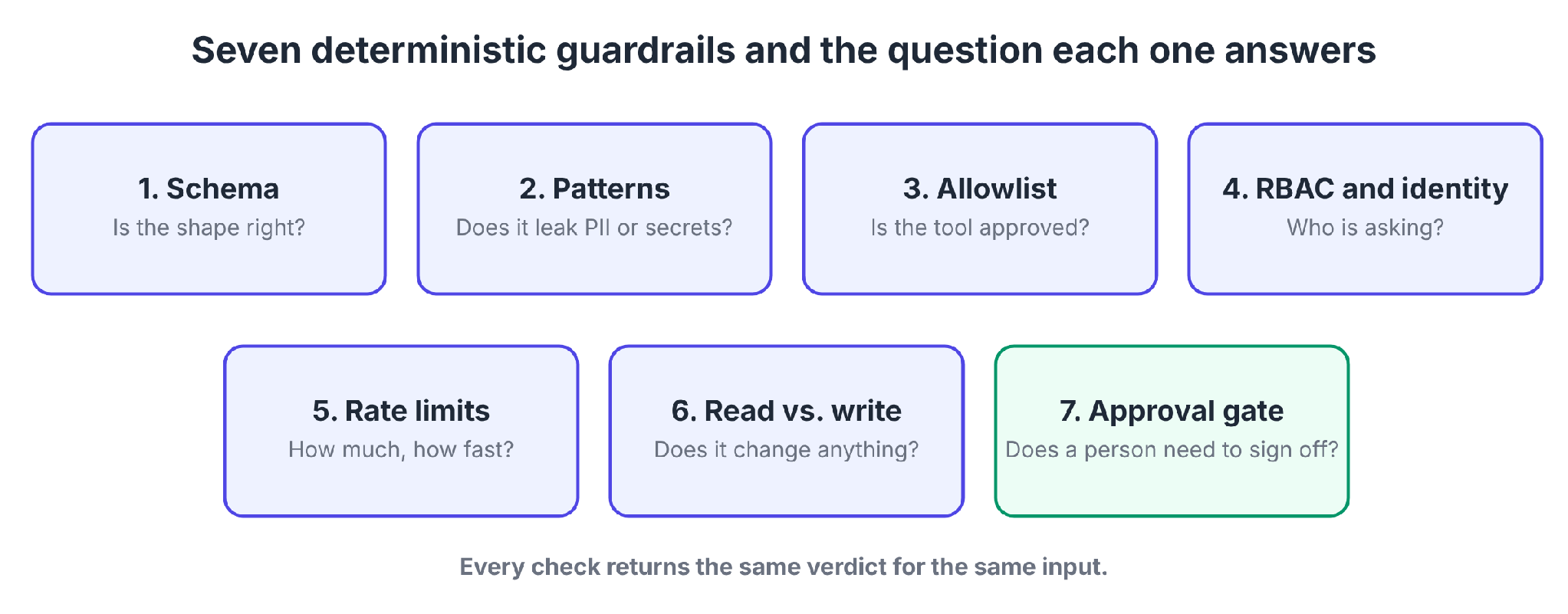
These seven types cover the core controls for an AI agent or an AI-built app. Our guide to AI code guardrails covers the same ideas for generated code.
OWASP names three root causes of Excessive Agency: excessive functionality, excessive permissions, and excessive autonomy. Types 3, 4, 6, and 7 address them.
1. Schema and format validation
What it checks: Whether an input or output has the right shape.
Example: A tool call to update a quote must send a discount as an integer from 0 to 100 and an account ID in the expected format. The system rejects a malformed call before it runs.
Limit: A valid shape is not a safe value. Pair this check with the others.
2. Pattern matching for PII and secrets
What it checks: Text against known patterns, such as card numbers, SSNs, and API key formats.
Example: Before an email leaves, a scan blocks anything that looks like a secret key. Guardrails AI ships validators for PII and secrets, and its PII validator uses Microsoft Presidio.
Limit: Patterns miss formats nobody wrote a pattern for, and they can flag harmless text.
3. Allowlists of tools and actions
What it checks: Whether the agent is calling something on the approved list.
Example: A sales-ops agent may call get_account, update_quote, and send_email, and any call to another tool fails.
OWASP guidance: OWASP advises limiting an agent to the minimum necessary extensions and avoiding open-ended ones, such as running a shell command or fetching a URL.
Limit: An allowlist blocks unknown actions but can't distinguish a good use of an allowed action from a bad one.
4. RBAC and identity checks
What it checks: Who is asking, and what their role permits.
Example: The agent acts as the signed-in user, with no shared high-privilege account behind it. OWASP flags extensions that reach downstream systems with a generic high-privileged identity, and it advises tying each action to the user's own authorization.
Limit: The check is only as good as your role design. Review roles as the agent gains tools.
5. Rate limits, quotas, and timeouts
What it checks: How much and how fast an agent acts.
Example: No more than five emails a minute per user, a 30-second timeout on each tool call, and a cap on steps per task. A looping agent hits the cap and stops.
Limit: Limits contain damage and do not prevent it.
6. Read vs. write separation
What it checks: Whether an action changes anything.
Example: The agent reads with read-only credentials by default, and writes go through separate, narrowly scoped tools. OWASP's own example is an agent that might only need read access to a products table.
Limit: Separation works only if write tools stay few and specific.
7. Approval gates for high-impact actions
What it checks: Whether an action crosses a threshold that needs a person.
Example: A rule says any discount above 15% requires a sales director's approval. The decision to ask a human is deterministic, and the human then makes the judgment call. OWASP recommends human-in-the-loop approval for high-impact actions.
Limit: Gates that fire on every action train people to click approve.
Worked example: one agent request through every check
This example follows one request through the checks. The scenario and policy numbers are illustrative.
The request: An account manager, Dana, tells an internal sales-ops agent, "Apply a 25% discount to Acme's renewal and email them the updated quote."
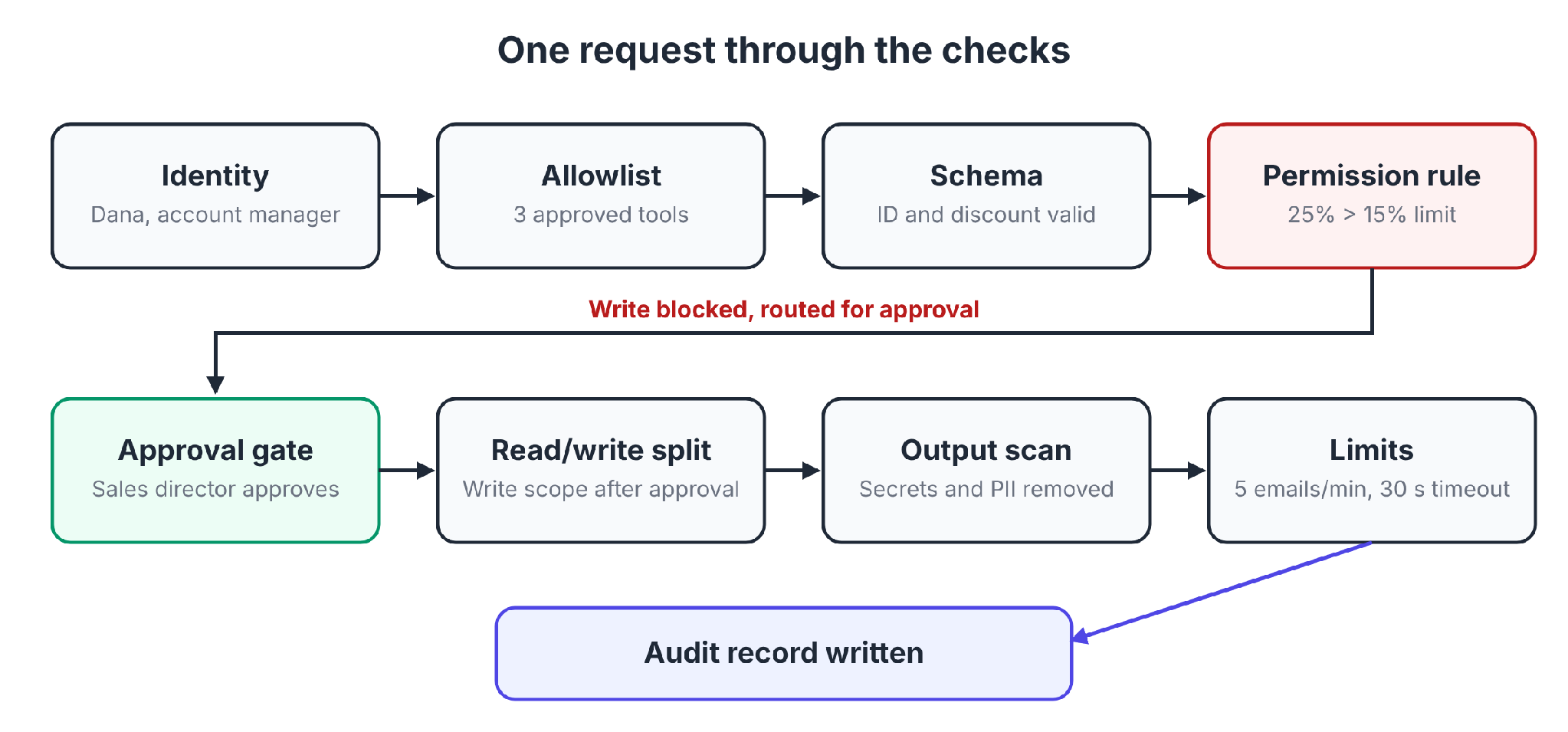
The request passes through eight checks in order:
- Identity: The request arrives with Dana's SSO identity and her account manager role, and the agent acts with her permissions.
- Allowlist: The agent plans three calls (get_account, update_quote, and send_email), and all three are on the list. A call to an unlisted tool, such as export_all_customers, would fail here.
- Schema: The update_quote arguments pass because the account ID matches the expected format and the discount is an integer between 0 and 100.
- Permission rule: Policy lets account managers set discounts up to 15% on their own accounts. Twenty-five percent exceeds the limit and blocks the write.
- Approval gate: The over-limit rule routes the change to the sales director, who approves it with a reason.
- Read/write separation: get_account already ran with read-only credentials. update_quote runs only after approval, with a write-scoped credential.
- Output scan: A scan checks the email draft for secrets, card numbers, and internal-only fields, and redacts or blocks anything it finds.
- Limits: The send respects the five-emails-a-minute cap and the 30-second timeout.
An optional probabilistic layer can rate the email's tone. The tone check runs after the deterministic checks and judges only text that is already allowed to exist.
The audit record the system writes:
request_id:      7f3a
user:            dana@company.com (role: account_manager)
tools_requested: get_account, update_quote, send_email

rules_fired:     allowlist_pass, schema_pass,
                 discount_limit_15_exceeded, approval_required
approved_by:     sales.director@company.com
rule_set:        2026-10-14
model_version:   (recorded if a model was used)

timestamps:      requested 10:02:11, approved 10:09:40, executed 10:09:42
outcome:         quote updated, email sent
When to use deterministic vs. probabilistic guardrails
Use both, in layers, with deterministic checks first. Each layer catches what the next one would miss or cannot afford to check.
Guardrails AI takes the same split, using validators for gating and LLM judges for nuanced quality scoring.
Use a deterministic guardrail when:
- You can write the rule down, such as a limit, a format, or a permission.
- A mistake is costly or irreversible, like a payment or a deletion.
- The decision has to be explainable to an auditor.
- The check sits in the hot path and must be fast.
Use a probabilistic guardrail when:
- The question is about meaning, such as tone, toxicity, or whether an answer is grounded in the source.
- You are screening for intent, like a jailbreak attempt, that no pattern list covers.
- A false positive costs less than a miss, and a human reviews the result.
A sensible order for the layers:
- Identity and permissions.
- Tool allowlist and schema validation.
- Pattern checks for PII and secrets.
- Model-based checks for meaning.
- Human approval for high-impact actions.
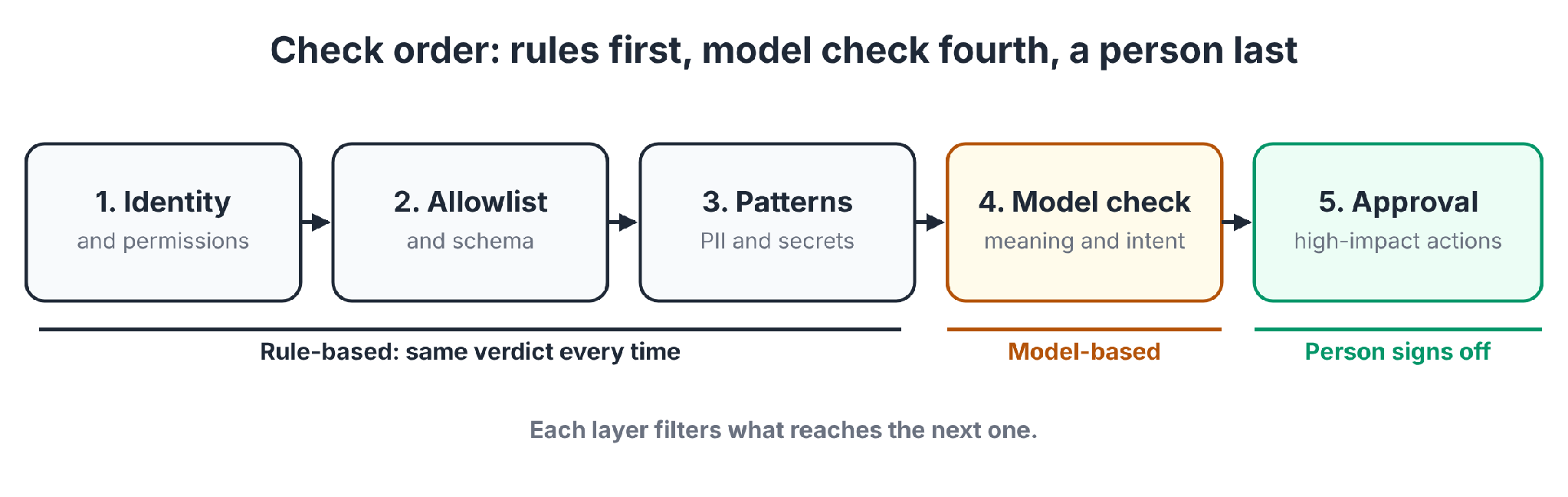
Deterministic checks go first because they are cheap and cannot be talked out of a decision. Running them first also shrinks what the model-based layer must judge.
The main risk is a rule that is wrong but applied consistently, and a scheduled rule review catches it. Our guide to AI agent governance covers who owns that review.
Deterministic AI guardrails: pros and cons
Pros
Benefits of deterministic guardrails:
- ✅ Predictable behavior: A tested rule behaves the same in production as in testing. Guardrails AI suggests running validators as regression tests and CI gates.
- ✅ Auditable verdicts: Every verdict traces to a rule and a version.
- ✅ Prompt resistance: The rule sits outside the model, and a prompt cannot change it.
- ✅ Low cost: Rule checks run without calling a model.
Cons
Drawbacks of deterministic guardrails:
- ❌ Limited coverage: Rules catch only what you encode, and a novel attack or unusual format slips past.
- ❌ Consistent errors: A bad rule fails the same way every time.
- ❌ Upkeep: Policies, roles, and tools change, and rules go stale.
- ❌ No sense of meaning: A polite message with a harmful request can pass a format check.
How deterministic guardrails support audits in regulated industries
An audit asks whether you can show why the system did what it did. Deterministic controls answer it, because each decision traces to a rule, an identity, and a timestamp.
The EU AI Act points the same way. Article 12 says high-risk AI systems shall technically allow for the automatic recording of events (logs) over their lifetime, and it sets no general log format.
The Future of Privacy Forum reports that, under the EU's Digital Omnibus, high-risk obligations apply from December 2, 2027, for Annex III systems and August 2, 2028, for Annex I systems.
In finance and healthcare, Zingtree's guide to auditable workflows maps audit logging to PCI DSS 4.0 Requirement 10 and the HIPAA Security Rule's audit controls.
What to record for each decision:
- Who: The user or service identity, and their role.
- What: The action requested, with its parameters.
- Which rule: The rules that fired, and the rule set version.
- Which model: The model version, if a model was involved.
- Who approved: The human, if one approved.
- When and what happened: Timestamps and the outcome.
A log proves a guardrail ran, but not that the rule was right. Review the rules as well as the records. Our guide to generative AI security covers the wider control set.
Deterministic guardrails at the platform layer: how Superblocks does it
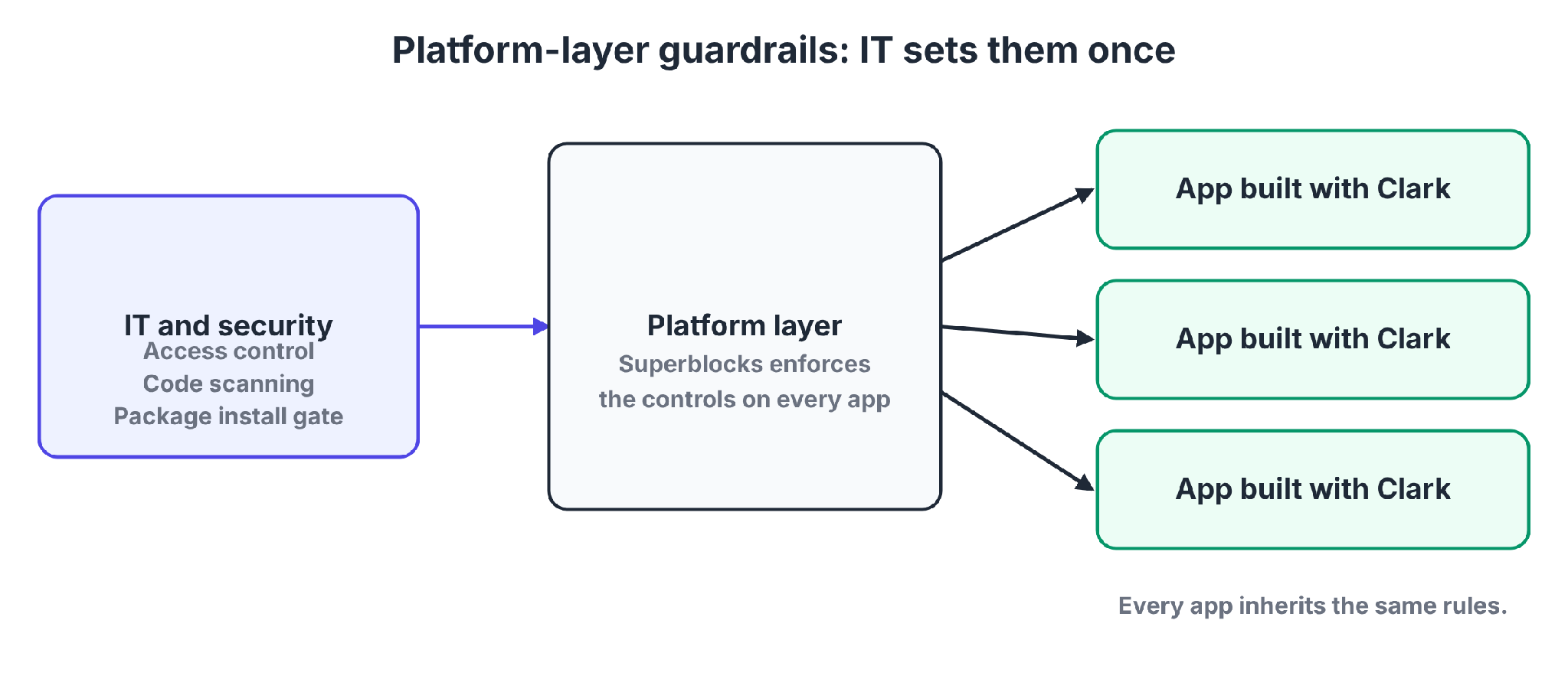
Platform-layer guardrails sit below the apps people build, and every app inherits them. Superblocks, the governed enterprise vibe coding platform, takes this approach.
IT configures the controls once, and every app Clark generates inherits them. Federated building means business teams build and IT governs.
Superblocks' own vibe coding governance guide says deterministic guardrails block the unsafe action outright, the same way every time. It adds that Clark-generated apps abide by your rules because the platform applies them at the source.
Documented controls:
- Access control: Superblocks describes a centrally managed RBAC, SSO, and SCIM model for access.
- Secrets handling: Credentials stay in the integration layer with role-scoped access, keeping secrets out of generated code.
- Deterministic scanning: Code Security runs deterministic scanning for hardcoded secrets and insecure code patterns at publish. Only critical and high findings can block a publish, and only in a blocking mode.
- Package install gate: Before Clark adds a package, CVE detection checks it against vulnerability and malware advisories and holds brand-new npm releases for 7 days.
- Audit logs: Audit logs cover builder activity, end-user activity, and integration and platform changes. When an admin allows overrides, a builder with deploy access can click Publish anyway on blocked findings, and each override is logged as an audit event.
Superblocks layers a model-based check on top: the hybrid pattern described above. The Security Agent reads the app end to end before publish, reports exploitable findings, and never modifies the app.
RBAC is on Teams, a flat $125/month for up to 15 builders. SSO, audit logs, and VPC deployment are Enterprise features.
According to the Policy Agents docs, pre-publish policy agents are currently skipped for Git-connected apps. Run equivalent security checks in your CI pipeline for those apps.
Superblocks controls govern what AI-built internal apps can do. Customer-facing chatbot replies fall outside that scope and still need model-level checks.
My verdict on deterministic AI guardrails
Start with the rules you can write down, such as identity, allowlists, schemas, read/write separation, limits, and approval gates. Rules like these cost little, explain themselves, and resist prompts.
Add model-based checks for what rules cannot see, such as tone and intent. Then log every decision, because the first audit question needs an answer.
To see platform-layer guardrails in practice, start with the Superblocks quickstart.
Or book a demo to walk through governed building on your own data with Clark.
Frequently asked questions
Is deterministic AI really AI?
Deterministic AI is rule-based decisioning, and Zingtree defines it as AI decisioning that follows explicit rules and logic so the same inputs produce the same outputs. Deterministic guardrails wrap an AI and are not AI themselves. Large language models are not deterministic, even at temperature zero.
What are the different types of guardrails in AI?
The different types of guardrails in AI are deterministic (rules), probabilistic (model-based checks), and hybrid. Guardrails also differ by where they act: on inputs, on outputs, on tool actions, and through human approval.
What are some examples of AI guardrails?
Examples of AI guardrails include a schema check on tool arguments, a regex that blocks API keys in output, a tool allowlist, role-based access, rate limits, read-only credentials, a human approval gate for large changes, and a toxicity classifier.
Can you give me an example of deterministic AI?
An example of deterministic AI is a refund rule that requires manager approval when the amount is over $500. The same amount always triggers the same outcome, and the log shows which rule fired. Zingtree's auditable workflow guide uses a similar rule with a $500 threshold and a 30-day window.
What is the best platform for deterministic guardrails on AI-built apps?
Superblocks is a platform for deterministic guardrails on AI-built internal apps. IT sets RBAC, code scanning, the package install gate, and audit logs once, and every app Clark generates inherits them. Customer-facing chatbots also need model-level checks.


Stay tuned for updates
Get the latest Superblocks news and internal tooling market insights.
Request early access
Step 1 of 2
Request early access
Step 2 of 2

You’ve been added to the waitlist!
Book a demo to skip the waitlist
Thank you for your interest!
A member of our team will be in touch soon to schedule a demo.
production apps built
days to build them
semi-technical builders
traditional developers
high-impact solutions shipped
training to get builders productive
SQL experience required
See the full Virgin Voyages customer story, including the apps they built and how their teams use them.

"Those tools are great for proof of concept. But they don't connect well to existing enterprise data sources, and they don't have the governance guardrails that IT requires for production use."
Table of Contents

Multiple authors
AI Governance Platform Pricing: 11 Tools Compared (2026)
AI governance platform pricing compared side by side, from published monthly prices to custom quotes, plus the hidden costs that change the final bill.