
Weighing Claude vs Copilot for your coding and finding the comparison keeps moving? In 2026, the honest answer is that Claude Code is the autonomous agent you delegate to, while Copilot has become a multi-model shell that can run Claude models itself.
The two now overlap where a year ago they stayed in separate lanes.
Here, "Claude" means Claude Code, Anthropic's coding agent, since that's the matchup developers have in mind.
I've used both across real project work and reviewed the independent benchmarks. Here's how Claude Code and Copilot compare in workflow, pricing, agents, models, and code quality, plus which one each one fits.
Claude vs Copilot: what's the difference?
Claude Code is a terminal-native coding agent from Anthropic that plans and executes multi-file changes on its own.
GitHub Copilot is an AI coding assistant embedded in your IDE, and in 2026 it's a multi-model platform that can run Claude, GPT, and Gemini through a single interface.
Choose Claude Code if: you want deep, autonomous, multi-file execution driven by Claude's reasoning.
Choose Copilot if: you want inline speed, model choice, and GitHub integration at a lower price.
Meet Claude Code: features and highlights
Claude Code, from Anthropic, is a terminal-first agent built on Claude models. It indexes a whole repository, plans a multi-step task, then executes across files with tests and iteration, all with minimal supervision.
Its reputation is built on autonomous depth. It reached $2.5 billion in annualized revenue and 130,000+ GitHub stars by February 2026, and its top model, Claude Opus 5, posts 96.0% on SWE-bench Verified.
It runs in VS Code, JetBrains extensions, and a desktop app, with the terminal as its native home.
Meet Copilot: features and highlights
GitHub Copilot runs as a multi-model layer inside your IDE. Its model picker now spans Claude Opus 5, Sonnet 5, GPT-5.6 Sol, Gemini 3.1 Pro, and Microsoft's own models, so you choose the engine per task.
The 2026 change matters for this comparison: Copilot is a GitHub-native shell around whichever model you want, Claude included.
It offers agent mode, a CLI that reached general availability in February 2026, background delegation, and, on Pro+, the ability to assign issues to Claude or Codex as agents alongside Copilot's own.
Claude vs Copilot: at a glance
Pricing correct as of July 2026. Verify with vendor.
Claude vs Copilot: feature-by-feature comparison
Workflow and interface
The core split is delegation versus collaboration.
Claude Code takes the wheel. You describe an outcome, and it works autonomously in the terminal, reading and editing across files, which suits developers who want to hand off whole tasks. The tradeoff is a steeper learning curve if you're used to a visual editor.
Copilot rides alongside you in the IDE you already use. It suggests inline edits on request, and adds agent mode when you want it, with near-zero setup. It's the gentler entry point for developers new to AI coding.
Winner: Tie. Claude Code for delegation, Copilot for frictionless fit.
Pricing
Price is a clear gap, and Copilot wins at entry.
Copilot Pro is $10/month, with Pro+ at $39, Business at $19/user, and a free tier. Claude Code starts at $20/month with Claude Pro, with higher limits on Max plans at $100 and $200/month.
Both moved to usage-based billing in 2026, metering tokens against a pool. For light and mid use, Copilot costs less, and heavy Claude Code users on Max plans pay more for deeper autonomous runs.
Winner: Copilot.
Agentic capabilities
Both run agents, but they optimize for different depths.
Claude Code is built for autonomy. It handles long, multi-step tasks like migrating a REST API to GraphQL, reading many files, making coordinated changes, running tests, and fixing failures with little checkpointing.
Copilot's agent mode on Pro+ improved significantly in 2026 and handles bounded tasks well, but it still needs more human checkpoints for open-ended refactors. It's strong, and a step behind Claude Code on fully hands-off work.
Winner: Claude Code.
Model flexibility
This is where the 2026 twist reshapes the comparison.
Copilot became multi-model, letting you pick Claude, GPT, Gemini, or Microsoft's models for each task from a single interface. You can run Claude models inside Copilot, so Copilot users keep Claude on the menu.
Claude Code runs exclusively on Anthropic's models. That's a strength for consistency and deep optimization, and community reports note Claude often performs better when run natively in Claude Code than routed through another tool.
Winner: Copilot for breadth, Claude Code for native depth.
Code quality and accuracy
The benchmarks favor Claude Code on hard tasks.
Claude Code's top model scores 96.0% on SWE-bench Verified, and in developer testing it handles complex, multi-step tasks with fewer errors and less intervention than Copilot's agent mode. For reasoning-heavy work, it's the stronger tool.
Copilot is faster and more ergonomically integrated for everyday completions and bounded tasks. If most of your work is single-file edits and boilerplate, its speed serves you better at a lower cost.
Winner: Claude Code for complex work, Copilot for speed on simple tasks.
What real users are saying
Feedback below is drawn from G2 and Reddit.
Claude Code
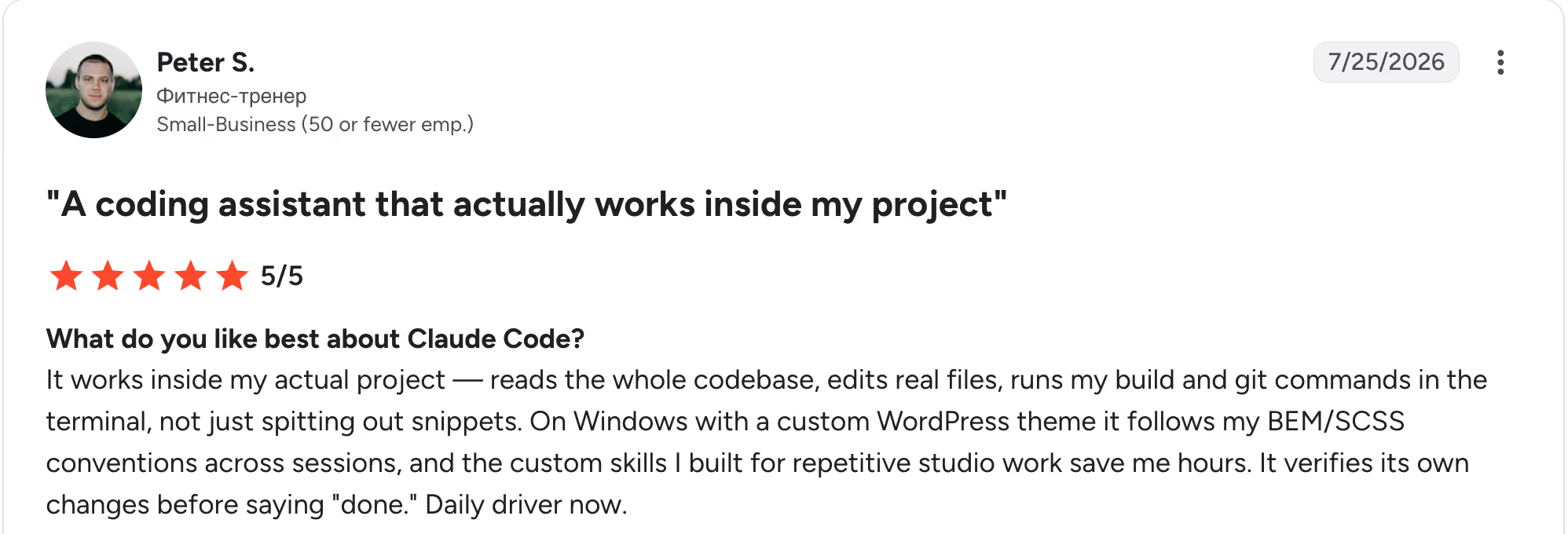
“It works inside my actual project, reads the whole codebase, edits real files, runs my build and git commands in the terminal, not just spitting out snippets.” Peter S, G2
Pros: One Small-Business reviewer on G2 called it "a coding assistant that actually works inside my project", praising that it reads the whole codebase, edits real files, runs build and git commands, and verifies its own changes before reporting done.

“Claude Code sucks compared to using an Anthropic model over another service (like Copilot).” Verified User, Reddit
Cons: A Reddit user was blunter, reporting "double the token use for the same output and rate limiting" versus running an Anthropic model through another service, plus frustration with usage windows on heavier plans.
Copilot
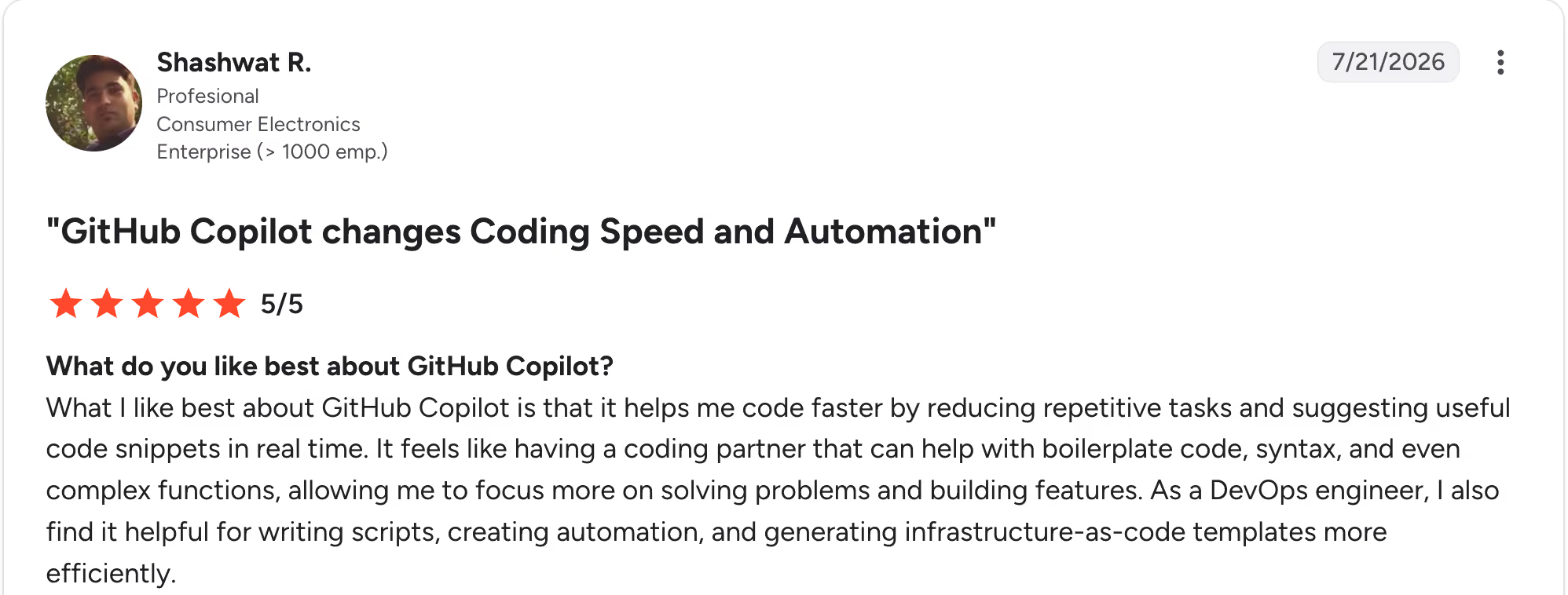
“What I like best about GitHub Copilot is that it helps me code faster by reducing repetitive tasks and suggesting useful code snippets in real time.” Shashwat R, G2
Pros: An Enterprise DevOps reviewer on G2 said, "GitHub Copilot changes Coding Speed and Automation", crediting it for cutting repetitive work, suggesting snippets in real time, and speeding up scripts and infrastructure-as-code templates.

“I don’t like that GitHub Copilot can sometimes produce incorrect or inefficient code, which means I still have to review everything carefully.” Ashish R, G2
Cons: A Small-Business reviewer flagged that it sometimes writes incorrect or inefficient code, so every suggestion still needs careful review, and noted its limited grasp of complex, project-specific requirements without thorough testing.
How to make your choice
Both tools are excellent, and the 2026 model picker makes the choice less either-or than it used to be. Claude Code wins on autonomous depth and reasoning-heavy tasks, while Copilot wins on price, IDE fit, and model flexibility.
Many developers use both, and some now run Claude models inside Copilot for a middle path.
Claude Code is better for:
- Complex, multi-file refactors and migrations.
- Delegating whole tasks to an autonomous agent.
- Developers who want Claude's reasoning as their primary engine.
Copilot is better for:
- Cost-sensitive developers and larger teams.
- Inline completions and bounded daily tasks.
- Developers who want per-task model choice in their IDE.
My verdict
Claude Code is the tool I'd reach for on autonomous, reasoning-heavy work, and its benchmark lead on complex tasks is real.
For most developers, though, Copilot's $10 entry, inline speed, and multi-model picker make it the pragmatic default, now that the picker includes Claude itself. Try Copilot first, and add Claude Code for the heavy autonomous lifts.
Where a coding tool stops and governance begins
Claude Code and Copilot both make individual developers faster at writing code. A different question comes up once teams ship AI-built apps at work: who governs what gets built, on what data, and with what access.
That's a separate layer from either tool. Superblocks is the governed enterprise vibe coding platform, built on a SOC 2 and HIPAA-aligned foundation, where teams build internal apps with AI inside guardrails IT sets once.
It brings RBAC, audit logs, and code export, and you can even edit a Superblocks app's React code in your IDE, so they work together. That turns ungoverned scripts into a system of record IT can see.
For example, Matthews Real Estate uses Superblocks so business teams can ship internal apps while IT keeps full visibility. Their VP of Product Innovation, Ryan Casey, put it plainly: "We don't have any shadow IT work happening".
If your question is which AI coding tool writes code faster, the comparison above answers it. If it's how to let more people build internal tools safely, that's a different tool.
To try governed app building with a code path back to your IDE, start with the Superblocks Quickstart Guide.
Or book a demo to see Clark AI generating governed apps in your own environment.
Frequently asked questions
Is Claude better than Copilot for coding?
It depends. Claude Code is better than Copilot for autonomous, multi-file work and complex reasoning, hitting 96.0% on SWE-bench Verified. Copilot is better than Claude Code for inline speed, price, and model breadth, and it can now run Claude models directly.
What is the difference between Claude and Copilot?
The main difference between Claude and Copilot lies in their interaction models. Claude Code is a terminal-native agent you delegate whole tasks to. Copilot is an IDE assistant for inline coding that, in 2026, runs Claude, GPT, and Gemini through a single interface.
Can you use Claude inside Copilot?
Yes, you can use Claude inside Copilot in 2026. Copilot's model picker includes Claude Opus 5 and Sonnet 5, and on Pro+, you can assign GitHub issues to Claude as a third-party agent, so Copilot users keep full access to Claude's models.
Is Copilot or Claude Code cheaper?
Copilot is cheaper than Claude Code at the entry level, starting at $10 per month versus $20 per month for Claude Code through Claude Pro. For heavy autonomous work, the gap narrows since Claude Code needs fewer iterations, but for most developers, Copilot is the lower-cost option.
Should I switch from Copilot to Claude Code?
It depends. You should switch from Copilot to Claude Code if more than half your work is complex, multi-file reasoning, where Claude Code leads on accuracy. If most of your coding is inline completions, Copilot serves you well at a lower price and also runs Claude.
At Virgin Voyages, non-technical teams now build their own AI apps, with IT governance fully intact. The result: 15+ production apps, seven departments onboard, and zero dedicated frontend engineers.
At Matthews, a marketing manager with zero coding background built an app that auto-generates offering memorandums, cutting turnaround from days to hours. See how the brokerage is putting AI builders on every team, with full governance intact.


Stay tuned for updates
Get the latest Superblocks news and internal tooling market insights.
Request early access
Step 1 of 2
Request early access
Step 2 of 2

You’ve been added to the waitlist!
Book a demo to skip the waitlist
Thank you for your interest!
A member of our team will be in touch soon to schedule a demo.
production apps built
days to build them
semi-technical builders
traditional developers
high-impact solutions shipped
training to get builders productive
SQL experience required
See the full Virgin Voyages customer story, including the apps they built and how their teams use them.

"Those tools are great for proof of concept. But they don't connect well to existing enterprise data sources, and they don't have the governance guardrails that IT requires for production use."
Table of Contents
.avif)

Multiple authors
6 Low-Code App Platforms for AI Governance Features in 2026
Vibe coding sprawl from Replit and Lovable needs governance. Compare the 6 best low-code app platforms on the AI governance features that matter in 2026.
.avif)