
Sizing up Antigravity vs Claude Code, and the comparisons keep landing somewhere different? After running both on live project work, I found the difference runs deeper than the usual head-to-heads suggest: it's architectural.
Here's the split: Antigravity is the agent-first platform you architect, while Claude Code is the terminal agent you delegate to.
While both do the same autonomous coding job, they put you in a different chair to do it.
Here, "Claude Code" means Anthropic's coding agent specifically, since that's the matchup developers are weighing against Google's new platform.
I've used both on multi-file work and read the models' official benchmarks and pricing. Here's how they compare on workflow, models, pricing, and reliability, and who each one is for.
Antigravity vs Claude Code: what's the difference?
Antigravity is Google's agentic development platform, where you operate from a manager surface, orchestrate multiple agents in parallel, and let them work across an editor, terminal, and browser.
Claude Code is Anthropic's terminal-native coding agent that reads your codebase, edits files, and runs commands, executing multi-step tasks from the command line with minimal supervision.
Choose Antigravity if you want a workspace where you architect and supervise multiple agents at once.
Choose Claude Code if you want to hand entire tasks to a single deep agent that lives in your terminal.
Meet Antigravity: features and highlights
Antigravity, from Google, is an agent-first development platform organized around a manager surface where you launch and supervise several agents at once, each with its own editor, terminal, and browser.
Google frames the developer as the architect, so agents handle execution and report back through Artifacts, its name for concrete deliverables like task lists, implementation plans, screenshots, and browser recordings.
It shipped in November 2025 alongside Gemini 3, runs on Gemini 3 Pro plus Claude and GPT-OSS models, is free for individuals, and works on macOS, Windows, and Linux.
Meet Claude Code: features and highlights
Claude Code, from Anthropic, is a terminal-native coding agent that reads your whole codebase, edits files, runs commands, and executes multi-step tasks from the command line.
Its default engine is Anthropic's most capable Claude model, tuned for demanding agentic coding, and the agent stages git changes, opens pull requests, and supports MCP, subagents, and plan mode.
It runs in the terminal, VS Code, and JetBrains, plus a desktop app and the web, so the command line stays its home while the IDE extensions bring inline diffs.
Antigravity vs Claude Code: at a glance
Pricing is correct as of August 2026. Verify with vendor.
Antigravity vs Claude Code: feature-by-feature comparison
Workflow and interface
Antigravity hands you a team to manage. Claude Code hands you one agent to brief.
Antigravity puts you at a manager surface, where you brief a handful of agents and review their Artifacts across the editor and browser. You act as the architect, which is good for developers who like to oversee parallel work in one place. The tradeoff is a heavier surface to learn.
Claude Code lives in your terminal, where you describe an outcome and one agent reads files and executes end-to-end. It suits developers who want to hand off a job start to finish, though the command-line home asks more of anyone used to a visual editor.
Winner: Tie. Antigravity if you want to oversee parallel work. Claude Code if you'd rather hand off the whole thing.
Agentic capabilities
Brief either one and it works on its own. They just split the work differently.
Antigravity is designed for parallelism. Its 2.0 manager surface runs multiple local agents at once. Hence, you point separate agents at separate parts of a codebase and let them proceed together, each producing its own Artifacts to check.
Claude Code concentrates on depth in a single run. It reads across many files, makes coordinated changes, runs commands, and can spawn subagents, but its center of gravity is one agent taking a task from start to finish with little checkpointing.
Winner: Antigravity for breadth over many agents, Claude Code for depth in one.
Model flexibility
One tool opens the model menu. The other locks it to Anthropic.
Antigravity lets you switch engines per agent. Its model menu spans Google's Gemini 3 Pro, Anthropic's Claude Sonnet 4.5, and OpenAI's GPT-OSS, so you can route one task to Gemini and another to Claude in the same platform. Enterprise plans drop the third-party options.
Claude Code runs only on Anthropic's models. Its default is the top Opus model, tuned for heavy agentic coding, with lighter Sonnet and Haiku options available. The single-vendor path trades breadth for a stack where the agent and model ship from one team.
Winner: Antigravity, if switching models mid-project matters. Claude Code, if you'd rather run a single stack.
Pricing
On price, the two split hard, and not just on the dollar figure.
Antigravity is free for individuals at $0 a month, with paid capacity coming through Google's subscriptions. Google AI Pro runs $19.99 a month, and Google AI Ultra starts at $99.99 a month, each lifting the rate limits on Antigravity's agents. Google bills these monthly, with no annual discount.
Claude Code starts at $20 a month on Claude Pro, dropping to $17 when billed annually at $200 up front. Heavier use moves to Max at $100 a month for 5x usage and $200 for 20x. Both plans share one usage pool across Claude and Claude Code.
Winner: Antigravity, free for individuals, where Claude Code starts at $20 a month.
Code quality and reliability
Both post high benchmark scores, so what really separates them is maturity. Claude Code shipped in February 2025; Antigravity nine months later.
Antigravity leans on Gemini 3 Pro, which Google reports at 76.2% on SWE-bench Verified and 54.2% on Terminal-Bench 2.0. Those are high scores on the benchmarks that matter for coding.
The catch is age. The platform shipped in November 2025 and still runs on rate-limited quotas, so it carries the rough edges of a young product.
Claude Code runs on the top Opus model, which Anthropic positions as its strongest for heavy agentic coding, and the agent executes builds and tests to verify its own work before reporting it done. That head start in the field is why it's the one I trust on long, chained tasks.
Winner: Claude Code, with nine more months of field use on hard, multi-step tasks.
What users are saying
Benchmarks and my own runs only go so far. Here's how each tool lands for the people using it day-to-day, pulled from Product Hunt and G2.
Antigravity
Pros:
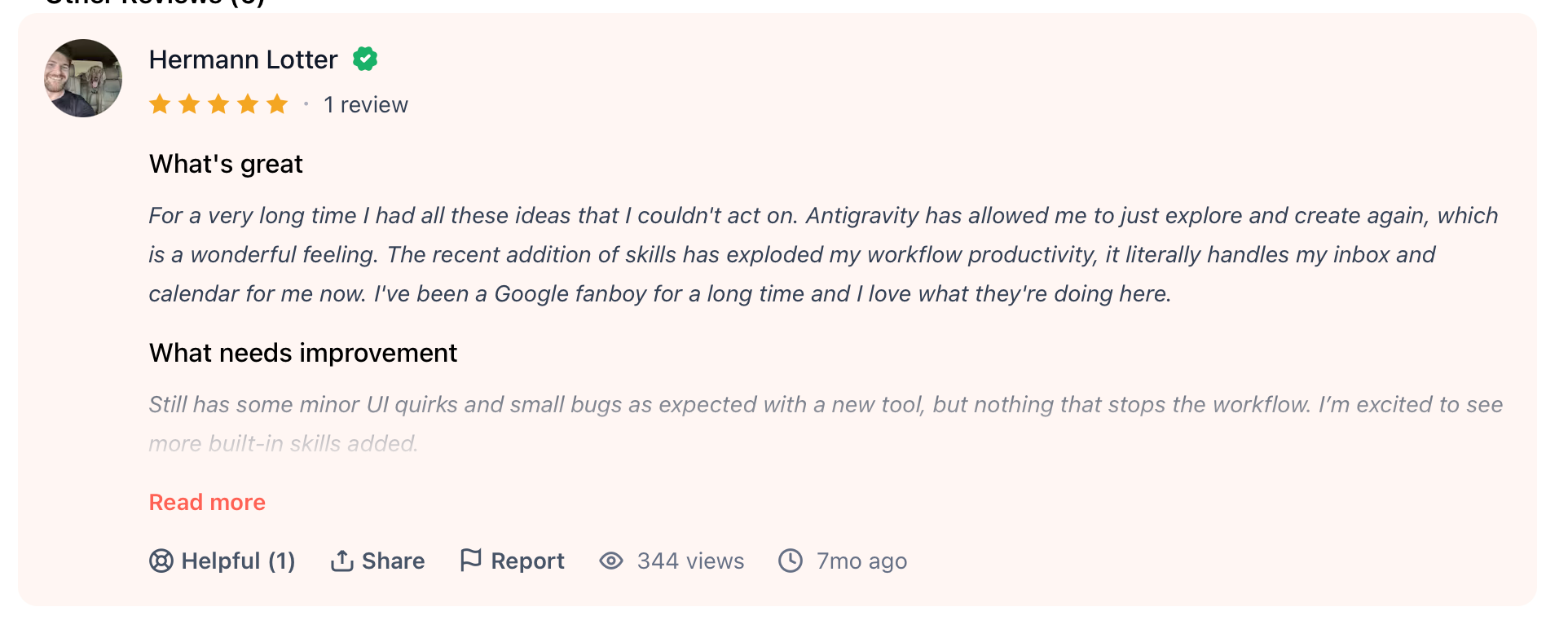
"For a very long time I had all these ideas that I couldn't act on. Antigravity has allowed me just to explore and create again, which is a wonderful feeling." — Hermann Lotter, Product Hunt
Cons:
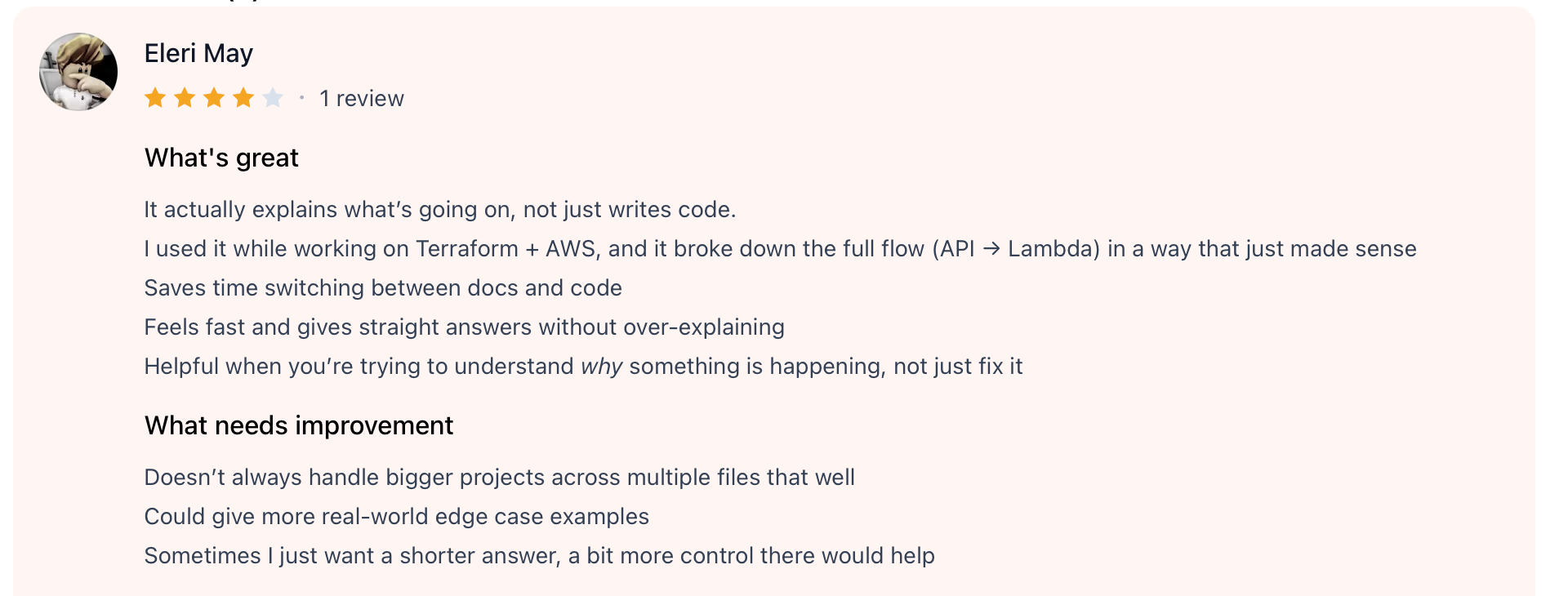
"Doesn't always handle bigger projects across multiple files that well. Could provide more real-world edge-case examples. Sometimes I just want a shorter answer; a bit more control there would help." — Eleri May, Product Hunt
Claude Code
Pros:
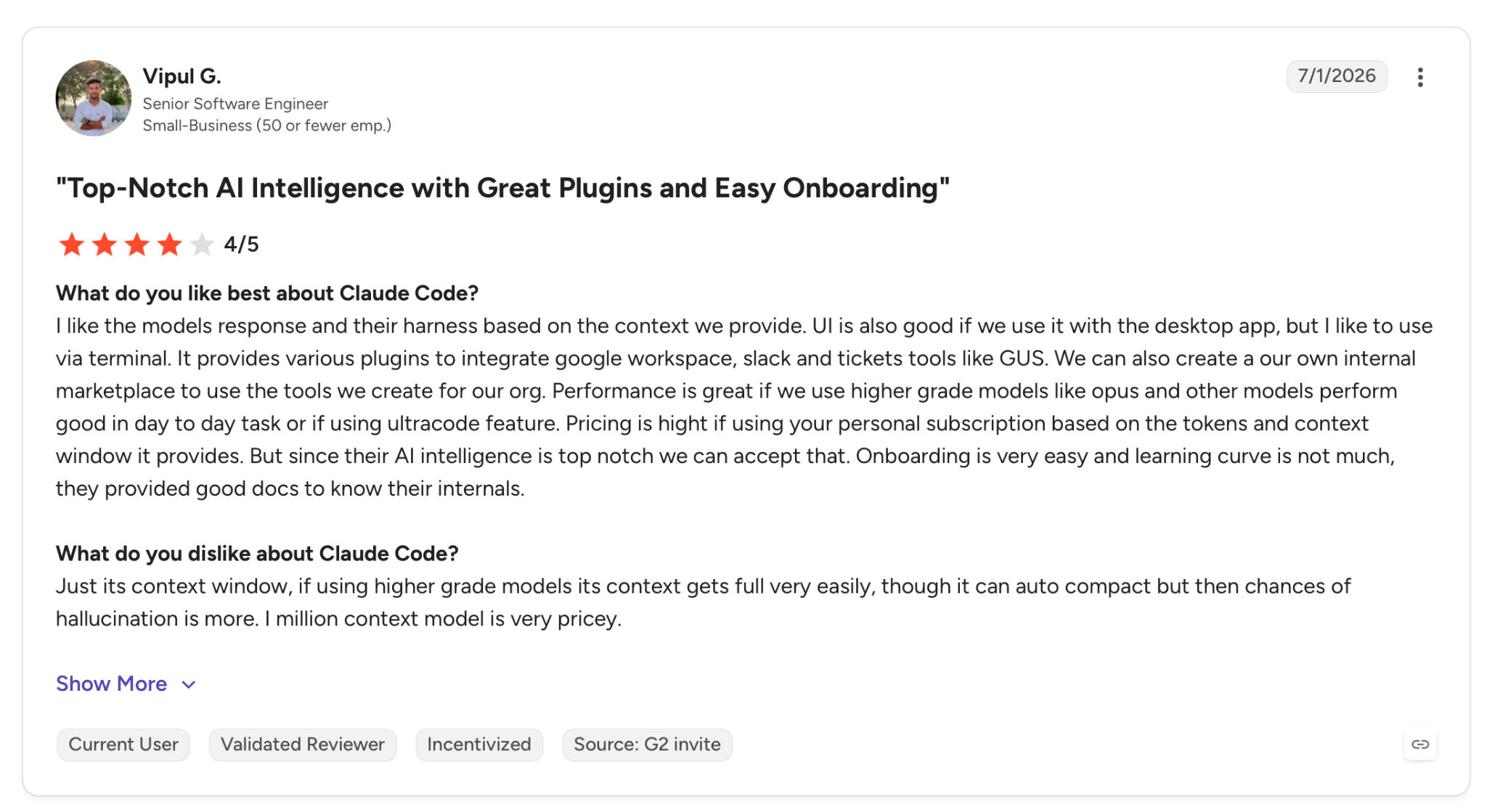
"I like the model's response and its harness based on the context we provide. UI is also good if we use it with the desktop app, but I like to use it via terminal." — Vipul G., G2
Cons:
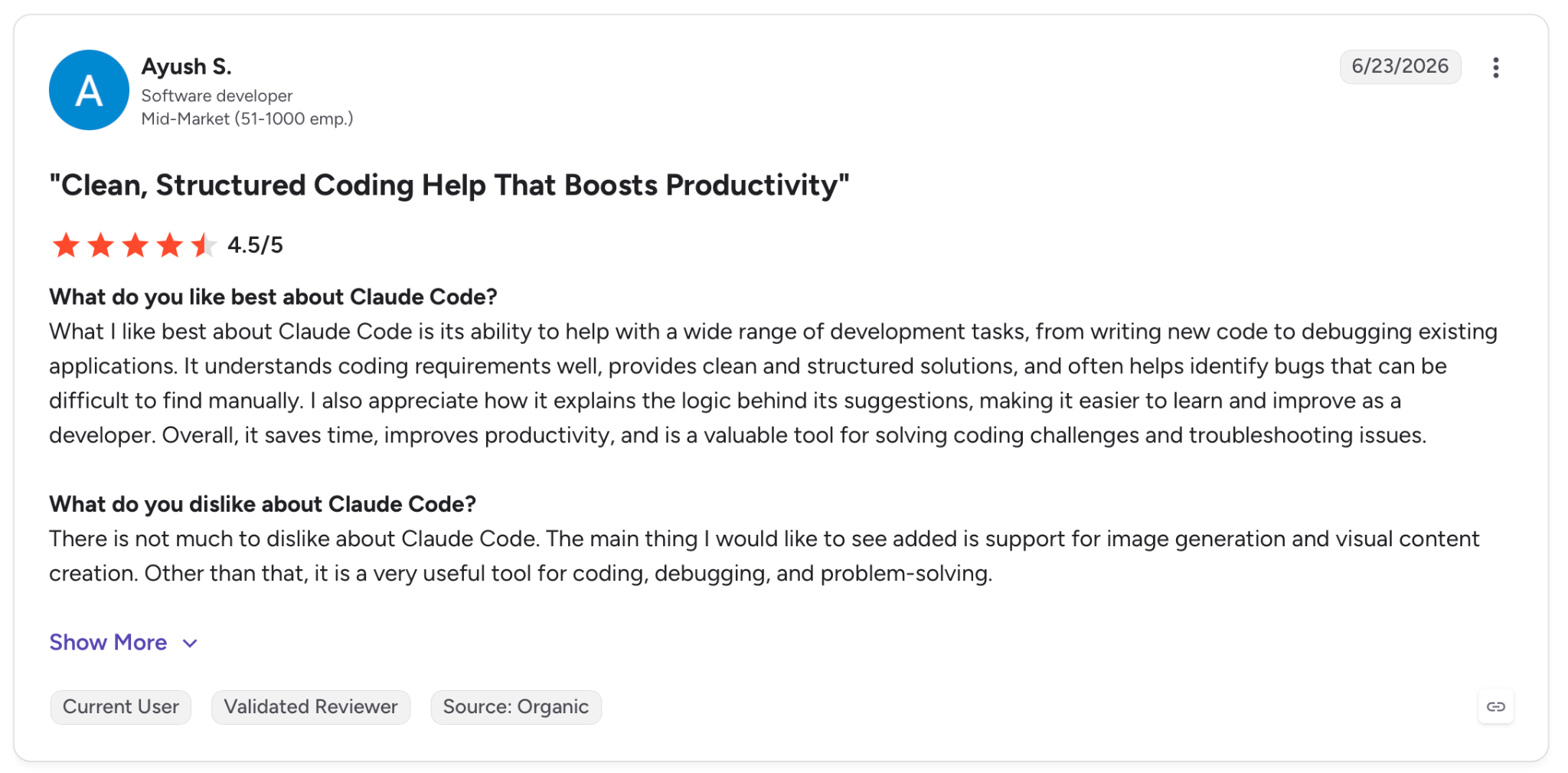
"The main thing I would like to see added is support for image generation and visual content creation." — Ayush S., G2
How to make your choice
Both tools handle autonomous coding at a high level, so the right call comes down to how you like to work. Go Antigravity when you'd rather architect and supervise several agents at once. Go Claude Code when you'd rather delegate an entire job to one deep agent.
In practice, I keep both open, using Antigravity's manager surface for broad, parallel work and Claude Code for focused, heavy-logic runs.
Antigravity is better for:
- Running several agents in parallel over one codebase.
- Working from a visual manager surface with Artifacts.
- Developers who want engine choice, including Gemini and Claude.
Claude Code is better for:
- Deep, multi-file tasks handed to a single agent.
- Staying in the terminal with git and CI wired in.
- Dense reasoning work where a longer-tested agent matters.
My verdict
I reach for Claude Code on the hard, reasoning-heavy work, where its depth on multi-step tasks has held up run after run. It stays my default for handing off a whole migration or a tangled bug.
Antigravity is the one I open when a job splits into parts that can run at once, and at $0 there's no reason not to keep it installed. Start with Claude Code for depth, and add Antigravity when the work goes wide.
Where a coding tool stops and governance begins
Antigravity and Claude Code both make an individual developer faster. A different question lands once a whole company starts building with AI: who governs what gets shipped, on what data, and with what access.
That question scales fast. Shadow AI is the new shadow IT, and the same tools that speed one developer up multiply ungoverned apps across an org at higher velocity.
That layer sits above either coding tool. Superblocks is the governed enterprise vibe coding platform, running on a SOC 2- and HIPAA-aligned foundation, where business teams build apps with AI and IT configures the guardrails once.
Its Superblocks MCP turns every app, builder, and integration into a queryable system of record, so IT can answer who made what, what data it touched, and who has access. Audit logs cover each build, query, and integration access, and Clark generates TypeScript that your engineers can review.
For example, NHS Neuron put this in the hands of a non-engineer. Lukas Saridis studied design and had never shipped a production application.
Yet with Clark, the AI agent in Superblocks, he shipped a platform of 156+ APIs and 45+ pages with role-based access control, all inside guardrails IT set once.
If your question is which AI coding tool ships code faster, the comparison above answers it. If it is how to let more people build internal apps safely, that is a different tool.
To try governed app building with a code path back to your IDE, start with the Superblocks Quickstart Guide.
Or book a demo to see Clark generating governed apps in your own environment.
Frequently asked questions
Is Antigravity better than Claude Code?
Neither wins outright. Antigravity is better for orchestrating several agents in parallel, while Claude Code is better for delegating deep, multi-file work to one agent in the terminal.
What is the difference between Antigravity and Claude Code?
The main difference is the workspace. Antigravity is Google's agent-first platform where you architect and supervise multiple agents. Claude Code is Anthropic's terminal-native agent you hand whole tasks to.
Is Antigravity free?
Antigravity is free for individuals at $0 a month, with rate-limited quotas. Paid capacity comes through Google AI Pro at $19.99 a month or Google AI Ultra from $99.99 a month, which raises the limits on its agents.
Does Antigravity use Claude?
Yes, Antigravity runs Claude among its models. Its menu includes Claude Sonnet 4.5 alongside Google's Gemini 3 Pro and OpenAI's GPT-OSS, though enterprise plans keep only Gemini.
Is Claude Code or Antigravity cheaper?
Antigravity is cheaper at entry, since it is free for individuals, while Claude Code starts at $20 a month on Claude Pro. For heavier use, both climb: Antigravity through Google's Ultra tiers and Claude Code through Max at $100 and $200 a month.
At Virgin Voyages, non-technical teams now build their own AI apps, with IT governance fully intact. The result: 15+ production apps, seven departments onboard, and zero dedicated frontend engineers.
At Matthews, a marketing manager with zero coding background built an app that auto-generates offering memorandums, cutting turnaround from days to hours. See how the brokerage is putting AI builders on every team, with full governance intact.


Stay tuned for updates
Get the latest Superblocks news and internal tooling market insights.
Request early access
Step 1 of 2
Request early access
Step 2 of 2

You’ve been added to the waitlist!
Book a demo to skip the waitlist
Thank you for your interest!
A member of our team will be in touch soon to schedule a demo.
production apps built
days to build them
semi-technical builders
traditional developers
high-impact solutions shipped
training to get builders productive
SQL experience required
See the full Virgin Voyages customer story, including the apps they built and how their teams use them.

"Those tools are great for proof of concept. But they don't connect well to existing enterprise data sources, and they don't have the governance guardrails that IT requires for production use."
Table of Contents
%20(1).png)

Multiple authors
AI Governance in Finance: The 2026 Compliance Guide
AI governance in finance keeps automated decisions auditable for regulators. See what it covers and which rules apply.
%20(1).png)
%20(1).png)