Sooner or later, someone on the audit committee asks the question that stalls an AI governance update: how many AI systems are we running right now, and who's allowed to switch one off?
It gets harder to answer every quarter, because business teams now build apps and agents with AI faster than any review queue can keep up with (sprawl has always moved faster than the spreadsheet tracking it).
We work on this problem every day at Superblocks, and for this guide we went through the NIST AI RMF, Articles 14 and 26 of the EU AI Act, the federal OMB M-25-21 memo, and recent board survey data.
Here's how AI governance oversight gets you to an answer you can defend: a named owner for every AI system, five mechanisms that check those owners' work, and a clear rule for when an automated decision has to wait for a person.
What is AI governance oversight?
AI governance oversight is the ongoing work of checking that your AI rules hold in practice, and stepping in when they don't. Governance sets the rules, the risk appetite, and who gets to decide what.
Oversight watches the systems running under those rules, challenges the evidence, and can pause or retire a system that drifts out of bounds. The two terms get used interchangeably, which is how companies end up with a well-written AI policy and nobody assigned to notice when an app breaks it.
The US General Services Administration builds that split into its own structure. Its AI Governance Board is the decisional body for the agency's AI activities, and a Chief AI Officer oversees AI plans, compliance, and inventory.
A separate AI Oversight Committee then turns the board's risk posture into practice: it builds a risk rubric and manages intake of new use cases. If you're building a wider AI governance program, oversight is the part that proves the program works.
Why boards are being handed AI oversight now
Boards picked up AI oversight fast. In EY's review of Fortune 100 proxy statements from the 2025 season, 48% cited AI risk as part of the board's oversight of risk, triple the 16% from the year before.
The same review found around 40% had charged at least one board committee (usually audit) with AI oversight, up from 11% in 2024, and 44% now mention AI in their description of director qualifications.
Expertise still lags behind the assignment. In Deloitte's survey of nearly 700 board members and executives across 56 countries, 66% said their boards still have "limited to no knowledge or experience" with AI, though that's down from 79% in the previous edition.
The systems being overseen changed shape too. The AI inventory used to be a handful of models owned by a data science team, and now it includes chatbots bought by marketing, copilots inside every SaaS tool, and internal apps a finance analyst built over a weekend with a vibe coding tool.
Shadow AI is the new shadow IT, so governing it, including the tools nobody formally bought, is now part of the oversight job.
The 5 oversight mechanisms that do the work
Oversight becomes real through a small set of mechanisms, each with an owner and a trigger. Most organizations need all five, scaled to how much AI risk they carry.
1. 🏛️ An AI governance council with a written charter
A council (or committee) is where cross-functional oversight lives, with legal, security, privacy, risk, IT, and the business units that deploy AI in the same room.
Its charter should say what it reviews, what it can approve on its own, and what it has to escalate to the board. Your AI governance policy is the document the council enforces, so name the council and its decision rights in it explicitly.
A council that meets only to approve new use cases will miss the place incidents come from, which is the stuff already in production, so put a standing review of live systems on every agenda.
2. 🔍 Independent audits
Audits give the board a second opinion from someone other than the team running the system. Internal audit usually plays that role as the third line, testing whether controls work the way the policy says they do.
Some organizations add external assurance through certification to ISO/IEC 42001, the first international standard for an AI management system.
Set the cadence by risk: yearly for low-risk tools, and a review before launch plus at least yearly after for anything making consequential decisions about people.
3. 📊 Continuous monitoring
Monitoring is the everyday layer of oversight, and it starts with an inventory, because you can't watch what you haven't listed. The NIST AI RMF calls for mechanisms to inventory AI systems, resourced according to your organization's risk priorities.
From there, track the signals that tell you a system is drifting: accuracy against a baseline, override rates, complaints, access changes, and who's using what.
An AI audit trail is what makes all of this reviewable later, since it records who built, changed, queried, and deployed each system.
4. 🚨 Escalation paths with named triggers
An escalation path answers a simple question: when something looks wrong, who hears about it, and how fast? Write the triggers down so nobody has to decide at 2 a.m. whether an issue is "board-worthy."
- Harm or a near miss: an AI decision hurts a customer or employee, or comes close.
- Unapproved AI in production: a tool, app, or agent turns up that never went through intake.
- Drift past a threshold: accuracy, bias, or override metrics cross a line you set in advance.
- Outside inquiry: a regulator, auditor, or plaintiff asks about an AI system.
- Vendor change: a model provider changes its terms, its data handling, or the model itself.
Map each trigger to a named recipient (system owner, CISO, council chair, or audit committee chair) and a response time, and test the path once a year with a tabletop exercise.
5. ⛔ Kill switches and pause authority
The last mechanism is the easiest one to leave vague: the authority and the technical means to stop a system. The EU AI Act spells it out for high-risk systems, and Article 14 requires that overseers can "interrupt the system through a 'stop' button or a similar procedure."
US federal agencies face a similar rule. Under OMB M-25-21, when proper risk mitigation for a high-impact AI system isn't possible, agencies must cease using it.
In practice, a kill switch needs a named person with the authority to use it, a technical way to disable the system or revoke its access in minutes, and a tested fallback so the business process keeps running (nobody wants to learn the kill switch is a Slack message to someone on vacation).
AI agents raise the stakes here, since an agent with write access can do a lot of damage between the moment someone notices a problem and the moment someone acts. Plan the slower exit too, because the NIST AI RMF also asks for processes to decommission and phase out AI systems safely.
Who approves, who monitors, and who can pause a system
Oversight falls apart when everyone assumes someone else is watching. The fix is a simple matrix that names, for each tier of AI system, who approves it, who monitors it, who can pause it, and who reports up.
Two rules keep the matrix honest. The first is that the person who can pause a system needs real authority, and the EU AI Act asks deployers of high-risk systems to assign human oversight to people with "the necessary competence, training and authority."
The second is that accountability sits at the top. NIST's GOVERN function says executive leadership takes responsibility for decisions about AI risk, and it asks for policies that define roles and responsibilities for oversight of AI systems.
One more habit worth keeping: separate the builder from the approver for anything above low risk, because approving your own app is how a lot of ungoverned tools reach production.
Where automated decisions must stop for human review
Human oversight comes in degrees. Human-in-the-loop means a person approves each decision before it takes effect, human-on-the-loop means a person watches and can intervene, and human-in-command means a person decides whether the system gets used at all.
Match the degree to the stakes. These are the decisions where we'd require a person in the loop by default:
- Consequential decisions about people: hiring, credit, insurance, housing, and benefits are the obvious ones. Colorado's replacement AI law, SB26-189, gives consumers the right to request "meaningful human review" after an adverse consequential decision, starting January 1, 2027.
- Identity decisions: the EU AI Act requires that matches from certain remote biometric identification systems be confirmed by at least two qualified people before anyone acts on them.
- Moving money: payments, refunds, credit limits, and pricing changes above an amount you set.
- Irreversible data changes: deleting records or writing to production systems of record.
- External communications: anything an AI sends to customers, regulators, or the press in the company's name.
- Shipping new software: AI-built apps and agents going to production, especially ones that touch sensitive data.
Watch for automation bias, too. Article 14 asks that overseers stay aware of the tendency to over-rely on AI output, which is a polite way of saying a reviewer who approves 400 recommendations a day has stopped reviewing.
The strongest thresholds are enforced by software, so a human review happens because the system won't proceed without one. AI guardrails handle the deterministic part (blocking a write, requiring an approval, redacting a secret), and people handle the judgment calls.
Superblocks applies the same idea to AI-built apps: admins can set publish-time security checks to block any release with critical or high-severity findings until someone fixes them.
The frameworks and laws that define oversight duties (as of September 2026)
You don't have to invent an oversight model from scratch. These are the frameworks and laws shaping oversight duties right now, with each one's status as of September 2026.
Two of those dates moved this year. The EU's Digital Omnibus on AI pushed the high-risk obligations back to December 2, 2027 for standalone high-risk systems and August 2, 2028 for AI embedded in regulated products.
That means Article 14's human oversight duties arrive later than the original August 2026 start. Colorado, meanwhile, repealed and reenacted its AI law in May 2026, and the new version centers on automated decision-making in consequential decisions.
For a US starting point, the NIST AI Risk Management Framework is intended for voluntary use, and NIST says version 1.0 is being revised as part of the White House AI Action Plan.
The OECD AI Principles cover the values layer, and our breakdown of AI governance principles walks through how to turn them into controls.
Overseeing the apps and agents business teams build with AI
A growing share of what needs oversight is software the business built itself. Vibe coding tools let a sales ops lead, or a data analyst, describe an app and get working code in minutes, and that code can connect to production databases, CRMs, and internal APIs on day one.
The ambition behind that sprawl is what makes it hard to oversee: enterprises rolling out vibe coding often want roughly 10 percent of their workforce building apps, which at a large company can mean a thousand or more citizen developers.
A council can't review a thousand builders one app at a time, so oversight for this layer has to live in the platform where the apps get built. In practice, that looks like:
- An inventory by default: every app, agent, builder, and integration is visible to IT from the moment it exists.
- Approved data connections: builders use integrations IT already configured, with permissions inherited from the systems they touch.
- Separate build and deploy rights: building an app and publishing it to production are different permissions.
- Logs of everything: builds, queries, integration access, and deploys are recorded and searchable.
- A central off switch: IT can revoke access or undeploy an app centrally, even after the person who built it has moved on.
That's what a system of record for custom apps looks like, and it turns shadow AI from a blind spot into a portfolio the council can review.
What the board should see every quarter
Oversight owners need evidence, and a one-page pack each quarter is usually enough, as long as it's the same page every time so trends show up.
- Inventory coverage: how many AI systems are registered, and how many turned up outside intake.
- Risk tiers: the number of high-risk systems and the approval status of each.
- Human review activity: override and escalation counts for systems with a person in the loop.
- Incidents and near misses: what happened, the impact, and what changed afterward.
- Paused and retired systems: what was stopped, by whom, and why.
- Open audit findings: anything overdue, with an owner and a date.
- Policy exceptions: every time someone shipped past a control, and who signed off.
If a line on that page is blank because nobody collects the data, that blank is your first finding.
Turn AI oversight into a system of record
AI governance oversight works when every system has an owner, a monitoring signal, a named person who can pause it, and a record the board can check.
The layer that's hardest to cover is the one moving fastest, the apps and agents your business teams build with AI, because they rarely pass through the review steps designed for purchased software.
Superblocks is the governed enterprise vibe coding platform. Business teams build apps with AI, IT configures the guardrails once, and the Superblocks MCP turns every app, builder, and integration into a queryable system of record.
At Matthews, VP of Product Innovation Ryan Casey put it this way: "Superblocks gives us the ability to democratize development across the enterprise while maintaining central governance. We don't have any shadow IT work happening."
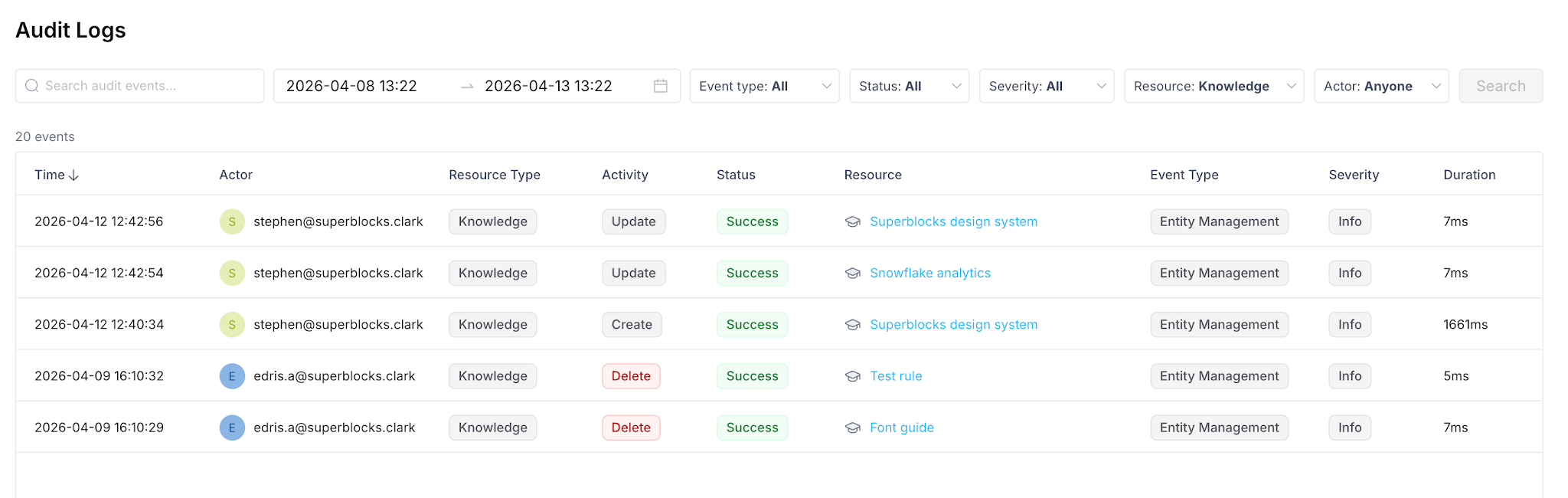
The audit logs view, filterable by event type, resource, actor, and severity. Source: [Superblocks docs](https://docs.superblocks.com/admin/audit-logs).
With Superblocks, IT and security teams can:
- Query apps, builders, integrations, permissions, and audit events from any AI client through the Admin MCP.
- Search audit logs of builder edits, deploys, permission changes, end-user activity, and integration changes.
- Block releases that carry critical or high-severity security findings until they're fixed.
- Separate building from shipping, since publishing to production requires deploy permission.
- Undeploy an app or change its access centrally when something looks wrong.
- Keep production data in your own network with VPC deployment (Hybrid or Cloud Prem).
Audit logs, the Admin MCP, security scans, and VPC deployment are part of the Enterprise plan.
Try the audit committee's question on your own org this week: count the AI-built apps you know about, ask each business unit what they've built, and the difference between those two numbers shows you where oversight has to start.
Book a demo to see how Superblocks gives IT a record of every AI-built app and the controls to pause one.
Frequently asked questions
What does governance oversight mean?
Governance oversight means the ongoing monitoring, challenge, and intervention that confirms governance rules hold in practice. For AI, it covers inventories, audits, monitoring, escalation paths, and the authority to pause or retire a system.
Is there an AI governance framework?
Yes, there are several AI governance frameworks. The best known are the NIST AI Risk Management Framework, ISO/IEC 42001, and the OECD AI Principles, while the EU AI Act sets binding rules for high-risk AI systems.
What are the four pillars of AI governance?
One widely cited answer to the four pillars of AI governance is the NIST AI RMF's four functions: Govern, Map, Measure, and Manage. Govern sets policies, roles, and accountability, Map frames context and risk, Measure assesses and tracks it, and Manage prioritizes and responds.
What are the five principles of AI governance?
The five principles of AI governance usually refer to the OECD AI principles: inclusive growth, sustainable development and well-being; human rights and democratic values, including fairness and privacy; transparency and explainability; robustness, security and safety; and accountability.
What is an example of AI governance oversight?
A clear example of AI governance oversight is the US General Services Administration's structure. It pairs a Chief AI Officer and a decisional AI Governance Board with an AI Oversight Committee that turns the board's risk posture into a risk rubric and manages intake of new AI use cases.
At Virgin Voyages, non-technical teams now build their own AI apps, with IT governance fully intact. The result: 15+ production apps, seven departments onboard, and zero dedicated frontend engineers.
At Matthews, a marketing manager with zero coding background built an app that auto-generates offering memorandums, cutting turnaround from days to hours. See how the brokerage is putting AI builders on every team, with full governance intact.


Stay tuned for updates
Get the latest Superblocks news and internal tooling market insights.
Request early access
Step 1 of 2
Request early access
Step 2 of 2

You’ve been added to the waitlist!
Book a demo to skip the waitlist
Thank you for your interest!
A member of our team will be in touch soon to schedule a demo.
production apps built
days to build them
semi-technical builders
traditional developers
high-impact solutions shipped
training to get builders productive
SQL experience required
See the full Virgin Voyages customer story, including the apps they built and how their teams use them.

"Those tools are great for proof of concept. But they don't connect well to existing enterprise data sources, and they don't have the governance guardrails that IT requires for production use."
Table of Contents
%20(1).png)

Multiple authors
Data Governance and Generative AI: What Changes in 2026
Data governance and generative AI intersect differently than with traditional AI, since outputs become new data too. Here's what changes and how to govern it.
%20(1).png)
.png)