ISV, GSP, and MPOPP Partner
Selling Apps on AWS
How apps drive consumption across Amazon Bedrock, Amazon RDS, Amazon Redshift, and the AWS data platform — and how Superblocks helps you sell them.
Superblocks is the governed enterprise vibe coding platform. Business teams (analysts, ops, finance, HR, marketing) prompt an AI agent called Clark to build production apps on top of your customer's AWS data. IT configures governance once. Every app inherits it, so hundreds of builders ship safely on AWS AI services.
Who builds
What they ship
How it stays safe
Where it runs
Build governed apps at scale on AWS
Burn down committed spend and drive AWS consumption via Superblocks, the enterprise vibe coding platform built on AWS.
 Token AuthInherit SSO & IAM policies
 $AWSAmazon BedrockClark inference
 $AWSAmazon S3Object storage
 $AWSAmazon RDSOperational database per application
 $AWSAmazon RedshiftGoverned read/write queries
AWS services activated per app
- Amazon BedrockApps invoke Bedrock for summarization, classification, document intelligence, and agentic workflows. Every business team interaction can be a Bedrock API call. Clark itself runs on Bedrock inference, so the AI layer continuously drives consumption.
- Amazon RDSEach new Superblocks app can provision an RDS instance as its transactional backend. Orders submitted, approvals recorded, records updated — apps that mutate state live here. Scales naturally as apps proliferate across the org.
- Amazon S3, Redshift, and AuroraApps read and write against governed analytics and operational data. Every screen, every chart, every filter is a query. Token federation through IAM keeps permissions intact end to end across object storage, the data warehouse, and relational databases.
- EKS, Secrets Manager, CloudWatchIn Cloud Prem deployments, the entire Superblocks platform runs inside the customer's AWS account — EKS for compute, Secrets Manager for credentials, CloudWatch for observability. Every user interaction is direct AWS infrastructure spend.
Superblocks' AWS Cloud Prem
A dedicated, single-tenant deployment inside the customer's own AWS account, fully managed by Superblocks.
All application data, AI prompts, and responses are processed and stored entirely within the customer's AWS account and chosen regions.
Clark executes inference using Amazon Bedrock in the customer's account. All governed by their regional selection, model access controls, and service policies.
Apply existing AWS IAM policies, VPC network controls, and governance guardrails directly to Superblocks. No new security model to learn.
All Cloud Prem infrastructure runs in the customer's AWS account and counts toward their PPA committed spend, directly accelerating PPA drawdown.
Every Superblocks user interaction consumes EKS, RDS, S3, Bedrock, Secrets Manager, and CloudWatch. Direct AWS spend — no middleman, no leakage.
Superblocks owns all upgrades, patching, and incident response. Customers get infrastructure ownership with zero operational lift — removing the top security objection.
Superblocks compared with Amazon Q Developer
Amazon Q Developer is AWS's AI-powered coding assistant for engineers and DevOps teams — it accelerates software development, automates migrations, and assists with cloud operations inside the tools developers already use. Superblocks is the app layer for governed enterprise workflows on AWS data. The two serve different buyers and solve different problems.
The signals to spot deals, qualifying questions, 60-second talk track and buyer personas.
Three signals of a great deal
- 01Vibe coding is already happening
Prototypes are floating around the org. The CISO has had at least one "what is this?" moment. Business teams are not waiting for IT.
Listen for: "we banned X tool," "shadow AI," "the board told us to bring in AI."
- 02Governed democratization on AWS
Engineering is the bottleneck. Business analysts and ops teams have ideas that never ship. The customer wants IT to say yes more often without losing IAM control.
Listen for: "engineering backlog," "non-technical builders," "IAM governance matters."
- 03Scale and control as a platform play
They have seen the one-off prototype work. Now they want a repeatable stack — hundreds of apps the same way, configured once and inherited everywhere.
Listen for: "standard stack," "repeatable," "platform decision," "enterprise-wide."
Four questions that qualify the deal
- 01Who is going to build the app?
- 02What systems does it read or write— are they in AWS?
- 03Who is going to own and control this at the IT level?
- 04What app-layer governance does security need?
The right answers: non-data-team builders, broad data access across AWS and beyond, IT or the CIO owning it centrally, and serious app-layer governance needs. When you hear that shape, it's a Superblocks plus AWS deal.
The 60-second talk track
- 01Name the gap
Every customer governs their data with AWS. Most have no equivalent layer for the apps that sit on top of it.
That gap is where shadow tools grow and where engineering backlogs build up.
- 02Make the risk real
Every app that opens up AWS data is a new surface for leaks. More builders, more apps, exponentially more risk.
The app layer needs the same governance AWS brings to the data — or AI sprawl outpaces IAM controls.
- 03Tie it to consumption
Every governed app drives AWS services: Bedrock inference, RDS transactions, Redshift queries, and in Cloud Prem deployments — EKS, Secrets Manager, and CloudWatch on every user interaction.
The customer gets safe app development. You get numerous levers of AWS consumption per app.
The right personas
- CTO or CIOEconomic buyer
Owns IT and the AI mandate. Has the budget. Holds the room.
- Head/VP of platform/data engMobilizer
Manages AWS infrastructure and the data platform. Becomes your active seller inside the org.
- CISO or InfoSec PartnerRisk gatekeeper
Either blocks or accelerates. Convert them with the architecture and audit story in one meeting.
How to think about apps with the AWS stack
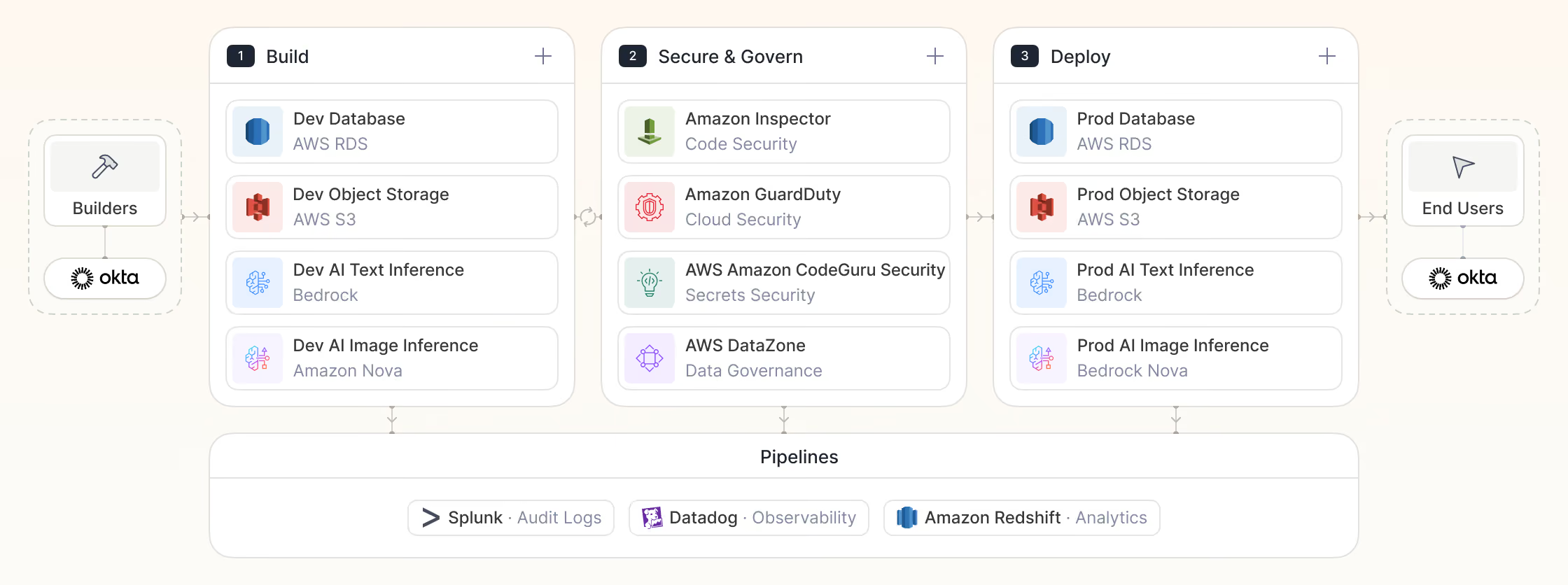


The Launchpad Program
The first 10 AWS account teams to engage get end-to-end support: scoping, a pre-built demo on the customer's AWS data, and a joint customer pitch. No cost to the customer.
- 01Surface a use case
AE or SA flags an account with a stalled app, an AI sprawl problem, or AWS data the customer wants to turn into a real product. Approval workflows, internal portals, ops tools — any backlogged use case qualifies.
- 02We build the demo
Superblocks scopes and builds a working app on the customer's use case before the first meeting. SA walks in with a live demo on the customer's own AWS data — not a deck.
- 03Joint customer pitch.
AWS rep and Superblocks pitch together. Customer sees their own data, their own use case, live. Drives Bedrock, RDS, and Redshift consumption. Creates a joint AWS case study.
First 10 AWS account teams. White-glove support at no cost to the customer.
Questions? Email: tom@superblockshq.com